- Stories
- Fanfiction
- Twelve Things Wade Is Not Allowed to Say
- Rules Five Through Eight
Rules Five Through Eight
The first thing I learned after Aunt May’s voicemail apocalypse was that you can’t trust a jar of “universal whistling” around anyone who still uses an answering machine. (Rule #5: Never, ever, bring a sentient sound device into a room where someone is trying to nap.) So when I strutted into the Avengers’ conference room—tucked between a half-eaten pizza box and a stack of Thor’s “Hammers for Beginners” pamphlets—I decided to test the theory one more time. I’d rigged the jar with a little extra “personality” upgrade, courtesy of a midnight hack on the Stark lab’s sound board, because why not give a whistling jar a sense of humor? (It’s not like the universe was going to mind a few extra giggles.)
“Okay, guys,” I said, slamming the jar onto the table like a sack of chips, “let’s see if the universe can handle a little… melodic interference.” Peter was already half-asleep in his chair, his spider-senses buzzing like an old fluorescent light, while Captain America stared at me like I’d just asked him to dance the Macarena at a state dinner.
Tony, of course, was already three steps ahead, his suit already humming a low bass line that made the floor vibrate. “Wade, buddy, are you sure this isn’t a… bio-weapon?” he asked, half-serious, half-teasing, while his helmet projected a hologram of a dancing avocado onto the wall.
“Only if you count a jar that can sing ‘Never Gonna Give You Up’ as a weapon,” I replied, flipping the lid off with a flourish that would have impressed any circus ringmaster. The jar emitted a bright, shrill whistle that rapidly morphed into a chorus of off-key karaoke. The room filled with an absurdly enthusiastic rendition of “Don’t Stop Believin’,” complete with a surprise sax solo that seemed to come from nowhere (I swear I saw a tiny ghost saxophonist perched on Thor’s hammer, but that might have been the after-effects of the sound).
For a moment, the Avengers were… dancing? Captain America tried to keep his composure, tapping his foot in perfect time, while Black Widow rolled her eyes so hard they might have been a separate weapon system. Thor, meanwhile, raised Mjolnir, summoned a bolt of lightning, and declared, “I shall conduct this glorious performance!” He aimed the bolt directly at the jar, which promptly exploded into a spray of glitter and confetti that settled on everyone’s helmets like a festive snowstorm.
The sound crescendoed, the lights flickered, and the entire building’s security system went into lockdown because the AI mistook the whistling for an intruder alarm. “Guys,” I shouted over the chaos, “I think we broke the building’s Wi-Fi!” (Rule #6: Never mix a sentient sound device with a high-tech security system unless you want the whole city to hear your karaoke.)
The next scene played out in the hallway outside the conference room, where I was forced to drag a very disgruntled Thor and a mildly annoyed Tony into the stairwell to explain what had just happened. “Wade,” Tony said, rubbing the back of his neck, “you just turned the Avengers Tower into a rave. That’s not… protocol.” I could see the gears turning in his head, probably calculating how much it would cost to replace the damaged sound-proofing.
“I was just trying to… you know, test the limits of what a jar can do,” I replied, gesturing wildly at the glitter that still clung to my suit. “And also to see if we could finally get a decent soundtrack for the next battle. You know, something with a beat.”
Thor stopped dead, his expression a mix of bewilderment and admiration. “You have the heart of a bard, little one,” he said, holding up Mjolnir as if it were a microphone. “Perhaps you shall become the court musician of Asgard!”
“Great,” I muttered, “now I’m on a quest to write the next Avengers theme song while dodging the wrath of a god who thinks I’m a rock star.”
We emerged from the stairwell into the lobby just as the building’s PA system crackled to life. An automated voice announced, “All tenants, please remain calm. A minor acoustic disturbance has been detected. Please enjoy the complimentary… disco ball.”
(That, of course, was the moment the entire city’s traffic lights started flashing to the beat of my jar’s final note, and the city’s taxis formed a synchronized conga line that wound around Times Square. The spectacle was glorious, if not entirely legal.)
By the time the glitter settled and the Avengers’ suits were re-calibrated, I had already compiled a new rule in the notebook that had survived Aunt May’s voicemail incident. “Rule #7: Never let a sound-producing jar near a super-powered team unless you’re prepared for a city-wide flash mob.” I scribbled it down with a pen that glowed a faint neon green—because I always keep a backup writing utensil for emergencies, which, as everyone knows, are just everyday occurrences when you’re a mutant-like hybrid of a mad scientist and a pool-side party planner.
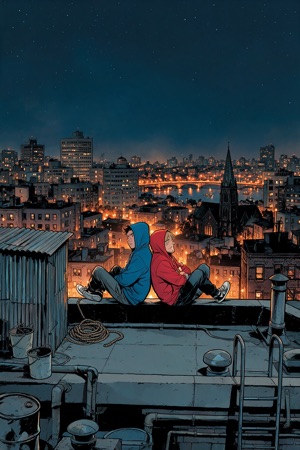
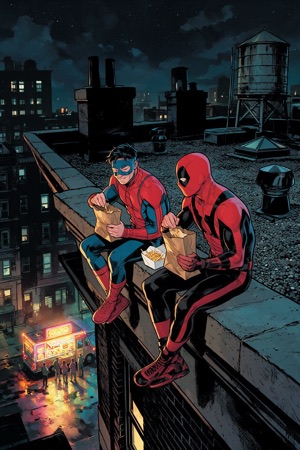
Peter found me later, perched on the edge of a rooftop, his spider-suit unzipped just enough to let the night air curl around his shoulders. He held the note with his gloved hand, the edges crisp, his eyes scanning the words like he was trying to decode a secret code.
“Wade,” he said, his voice a tired monotone that somehow still managed to sound like a lullaby, “I think we need to talk about the jar.”
I smirked, tossed the jar (now empty, but still humming a faint echo of the karaoke) onto the ledge, and replied, “Peter, you know me—always keeping the party going.”
He sighed, the sound as heavy as a subway train rolling over a broken track. “You know, there’s a limit to how many times we can turn New York into a nightclub before the city council sends a subpoena. And also, Aunt May’s voicemail—”
“—is basically a warning system for the universe,” I interjected, gesturing wildly with my hands, which made a dramatic “whoosh” that seemed to pull in a stray pigeon that promptly perched on my shoulder, looking very unimpressed. “I’m just saying, if we can’t have a little fun, then what’s the point? Besides, the city loves the flash mob. It’s like… a free PR stunt.”
Peter stared at the pigeon, then at me, his mask half-off, revealing a face that looked both exhausted and oddly hopeful. “Wade, there’s a line between ‘fun’ and ‘catastrophic.’ The note you wrote about the jar… it’s not just a note. It’s a reminder that we can’t keep playing with fire—or, in this case, glitter and sound—without consequences.”
The pigeon finally decided it was over, hopped off my shoulder, and squawked a warning that sounded suspiciously like, “Don’t trust a jar that whistles at midnight.” I laughed, but the laugh came out more like a cough, a breath that tried to hide the tremor underneath.
“Fine, fine,” I said, slipping my arms around his shoulders, “Rule #8: Never let a jar of “universal whistling” be the only thing keeping you from seeing the sunrise.” Peter turned his head, his eyes meeting mine, and for a split second—just a beat—he looked less like a tired hero and more like a man who missed the sound of his own heartbeat over the static of the world’s chaos.
We stood there, the night wind tugging at our suits, the city below humming with the after-effects of our accidental rave. In the distance, the Avengers Tower’s neon sign flickered, spelling out “Wade’s Whistling Jar” in an accidental homage that would make the internet explode for weeks.
I felt the weight of the notebook in my pocket, its pages filled with rules that were more like cautionary jokes than actual guidelines. I pulled it out, flipped to the last entry, and added a quick line in my best handwriting: “Rule #12: When you finally learn what you’re not allowed to say, you’ll realize you’ve already said it all along.” (That’s for later, obviously.)
Peter chuckled, a low, tired sound that seemed to crackle with a hint of genuine amusement. “You know, Wade, maybe the universe doesn’t need a universal whistling jar. Maybe it needs… a universal quiet moment.”
I stared at him, the idea of quiet feeling like a new kind of challenge. “Quiet, huh?” I said, tapping the empty jar. “I guess we could try… one night without any whistling. Just… silence. And maybe a taco.”
He raised an eyebrow, the only expression left on his face that could still be called amused. “A taco,” he repeated, “as a peace offering to the city?”
I grinned, the kind of grin that only a half-mad scientist with a penchant for chaos could pull off. “Exactly. And if that doesn’t work, I’ve got a backup plan involving a karaoke machine, a few extra glitter cannons, and a very reluctant Thor. But for now, let’s just… breathe.”
The pigeon, having circled back out of sheer curiosity, perched on the edge of the ledge, watching us like a tiny, judgemental audience. I gave it a half-nod, the kind of nod that said, “You’re welcome for the show.”
Peter exhaled, the breath sending a ripple through the city’s neon glow. “Alright, Wade. Let’s get you back to the lab. We’ve got rules to write, and apparently, a lot of cleaning up to do.”
I followed him down the fire escape, the night air cool against my face, the city’s lights pulsing like a heartbeat in sync with my own. Somewhere in the distance, a saxophone solo drifted from a rooftop bar, the melody oddly familiar, as if the universe were humming a lullaby to a weary hero and his chaotic counterpart.
We reached the lab, the door hissing open to reveal a room cluttered with beakers, wires, and a half-finished prototype that looked suspiciously like a miniature version of the jar—only this time, it didn’t whistle. It just sat there, silent, like a promise waiting to be broken.
Peter set the notebook down on a table, his fingers hovering over the page with Rule #8. “You think we can keep this… quiet thing going?” he asked, his voice softer than before, like a whisper that barely made it past the hum of the city.
I stared at the empty jar, at the glitter still clinging to the edges of the table, at the notebook’s final line, and felt a strange calm settle over the chaos. “Maybe,” I said, “but if the universe wants a song, we’ll just have to sing it together.”
He smiled—tiny, tired, but genuine—then turned to the prototype. “Let’s see if we can make something that only sings when we want it to.” He flicked a switch, and the device emitted a soft, melodic hum, barely audible over the distant traffic.
The hum grew, the room filling with a gentle chord that seemed to echo the promise of a new rule, a new beginning. It was absurd, it was chaotic, and it was exactly what we needed. And somewhere, deep in the back of my mind, I could hear the pigeon’s faint warning, like a tiny reminder that the universe is a lot more fragile than we like to think.
The night stretched out, the city’s neon lights flickering like fireflies, and I realized that maybe the real rule we were writing wasn’t about jars or whistling or even Avengers. It was about knowing when to turn down the volume, when to let the silence speak, and when, just for a moment, to let the world hear you laugh—loud, unapologetic, and completely, irreversibly, ourselves.

The app remembers where you stopped, reads chapters aloud, and works offline. Writing lives there too.