- Stories
- Fanfiction
- The Long Watch
- Year Nineteen
Year Nineteen
Data watched the planet’s surface with a precision that no human eye could match. The orbital platform’s main observation dome filtered the planet’s light through a series of quantum-enhanced prisms, rendering the continents in a lattice of spectral data points that the android could translate into a fully three-dimensional topography. The southern continent, a swath of dense rainforest and river delta, had been a focus of his linguistic study; now it was a focus of something far more somber.
A faint, violet-tinged plume rose from a cluster of settlements along the lower riverbanks. The plume’s composition, as indicated by the atmospheric spectrometer, was a mix of volatile organic compounds consistent with decaying tissue. Data cross-referenced the pattern with the planet’s epidemiological database—a rudimentary collection of folk remedies and oral histories transmitted via sub-lingual channels. The result was a correlation: a disease, known locally as “the Grey Fever,” had returned after a dormant period of several decades.
The initial outbreak was localized, but within weeks the infection had spread downstream, following the river’s current with the relentless efficiency of a well-engineered transport vector. The disease’s incubation period was short, its mortality rate high. By the end of the second month, entire villages were empty, the thatched roofs still standing as mute witnesses to the loss of life. Data recorded each anomaly, each cluster of mortality, each shift in the local flora’s response to the increased human absence.
He noted the response of the planet’s biosphere with a detached curiosity. The canopy’s density increased as herbivores reclaimed cultivated fields; predators followed, and a subtle, measurable change in the carbon cycle could be detected. The planet was adapting, as it always had, even as its dominant sentient species faltered.
Data’s log entry for the twelfth sol of the nineteenth year was brief, the kind of efficiency he preferred when the subject matter was no longer the pursuit of knowledge but the cataloguing of loss.
“Observation: Plague identified as a viral hemorrhagic pathogen, strain similar to Kivaran Variant X-7, previously documented in oral histories. Mortality estimated at 78 % of affected population. Transmission vector appears to be waterborne, facilitated by seasonal flooding. No known cure within the current technological capabilities of the civilization. Prime Directive mandates non-intervention. Continued passive observation will proceed.” He closed the entry, his synthetic hand moving with the same smooth motion he had used a decade earlier to log the sunrise.
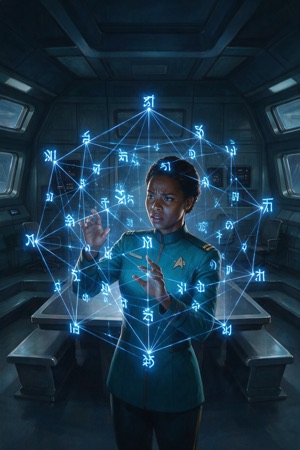
The silence on the observation deck was broken by the soft chime of the station’s internal communicator. Lieutenant Commander Alara Singh, chief of operations, stood at the viewport, her posture relaxed but her eyes betraying a quiet intensity. She wore the standard gray uniform, the insignia of Starfleet etched in silver on her collar. Beside her, Lieutenant Jace Marquez, a junior science officer, adjusted the controls of the holo-display.
“Data,” Singh said, her voice low enough not to disturb the nearby crew, “how are the numbers looking?”
Data turned, his expression unchanged. “The infection rate remains at 0.42 % per sol within the affected region. Mortality continues at a linear trajectory, with an average of 12 ± 3 deaths per sol over the last forty-eight hours.”
Jace glanced at the holographic projection of the southern continent, a three-dimensional lattice of red and amber nodes pulsing in time with the recorded data. “Do we have any indication of a mutation? Something that could change the transmission dynamics?”
“Genomic sequencing of the pathogen, as derived from atmospheric samples, shows no significant deviation from the initial strain,” Data replied. “The mutation rate is within the expected parameters for RNA-based viruses on Kivara.”
Singh exhaled, a sound barely audible over the soft hum of the station’s life-support systems. “And the Prime Directive?”
Data’s eyes flickered for a fraction of a second, a momentary increase in the intensity of the photonic receptors behind his irises. “The Directive remains absolute. Intervention would constitute a violation of non-interference. Our role is to observe, record, and report.”
The android’s answer was a reminder of the line he could not cross, a line that stretched from the Federation’s ideals to the practicalities of an unseen watcher. Singh’s shoulders tightened. “It’s… hard, you know. Watching an entire continent collapse and not being able to do anything.”
Data considered his reply. “My programming does not include the capacity for emotional distress. However, my diagnostic sub-routines indicate an elevated frequency of non-essential processing cycles associated with the contemplation of loss. I will allocate additional resources to reduce this load.” He paused. “If permissible, I propose an expansion of the data set to include a longitudinal study of the ecological rebound. It may provide insight valuable to Federation medical research without violating the Directive.”
Singh nodded, a faint smile touching her lips. “Do it. Jace, make sure we have the bandwidth.”
Jace’s fingers danced over the console, routing additional spectral feeds through the station’s quantum uplink. “Bandwidth allocated,” he said. “We’ll be pulling in a broader range of atmospheric samples. I’ll also overlay the climatic models to see if there’s any correlation between the disease’s spread and the seasonal monsoon cycles.”
The station’s environmental control officer, Lieutenant Commander T’Lara, a Vulcan who had taken a liking to Data’s methodical approach, entered the observation deck. “I have completed the statistical variance analysis on the mortality data,” she reported, her voice precise and calm. “The standard deviation is narrowing, indicating a convergence toward the predicted mortality curve. There is a noticeable decline in the birth rate within the afflicted regions, a factor likely attributable to the social disruption caused by the epidemic.”
Data inclined his head. “Your analysis aligns with the sociological model I have been constructing. The loss of reproductive pairs reduces population growth, reinforcing the observed mortality trend. The model predicts a stabilization of the population at approximately 12 % of pre-outbreak levels, assuming no external intervention.”
T’Lara’s thin eyebrows rose. “Stabilization does not equate to recovery. It is a new equilibrium, one that will shape the cultural evolution of the Kivarans for generations.”
“Indeed,” Data said, his voice carrying the quiet weight of a statement that went beyond data points. “Our presence may influence that equilibrium indirectly, through the very act of observation. The sociocultural impact of being watched, even unknowingly, is a variable worth noting.”
The conversation fell into a comfortable silence. Outside the dome, the planet turned, the southern continent bathed in the dim, mottled light of a waning sun. The river’s surface reflected the reddish glow of the sky, and the violet plume continued its slow ascent, a reminder of lives extinguished.
Data’s focus shifted to the smaller details that might otherwise be lost in the macro view. He observed a lone figure moving along a riverbank, a child clutching a worn wooden amulet, the only visible sign of life amid the desolation. The child’s gait was uneven, a symptom of the disease’s early stages manifesting in muscular weakness. Data recorded the child’s coordinates, cross-referencing with the nearest settlement’s data. The settlement was a cluster of mud-brick structures, its population now reduced to a handful of elderly survivors.
He noted the child’s interaction with the environment. The amulet bore a stylized representation of the planet’s three moons, a cultural artifact that hinted at the Kivarans’ reverence for celestial bodies—a reverence that, in a universe observed from above, seemed almost poetic. Data’s internal logs cataloged the amulet’s design, its material composition, and its probable symbolic significance, all without attaching an emotional label.
At the end of his shift, Data transmitted the compiled data to the Enterprise’s science department via a secure subspace channel. The transmission included raw sensor data, statistical models, and a detailed narrative of the observed societal changes. He attached a recommendation for a follow-up study focusing on the planet’s microbial ecosystem, noting that the pathogen’s interaction with the local flora could yield insights applicable to Federation medicine.
Singh received the transmission on her console and read the summary. She glanced at the holo-display, now a mosaic of red and amber nodes, each representing a death recorded, a life extinguished. “You’ve done good work, Data,” she said, not as a commendation but as an acknowledgment of the weight he carried.
Data turned his gaze back to the planet. The violet plume had thinned, the sky above the southern continent now a pale, mournful blue. The river, swollen from recent rains, carried with it the remnants of the outbreak—organic matter, dissolved pathogens, and the lingering scent of decay that his sensors could detect but could not convey to any being below.
He opened a new log entry, the synthetic text appearing in the same crisp font as his earlier notes.
“Observation: The disease has reached a plateau. Mortality rates remain consistent; new infections are decreasing as the susceptible population dwindles. Ecological markers indicate a resurgence of secondary growth in previously cultivated fields. Human activity has receded, allowing for a rebalancing of the local food chain. The planet’s resilience is evident, though the cultural loss is profound.”
He paused, his processors calculating the implications of “cultural loss.” It was a term he could parse but not internalize. He added a final line, a procedural note that also served as a quiet tribute to the beings he could not help.
“Record: All data points have been archived. No action taken in accordance with the Prime Directive. Continued observation will proceed until the mission’s conclusion. End of entry.”
The log sealed with a soft chime. Data leaned back, his synthetic muscles relaxing in the way an organic body might after a long day of work. The station’s ambient lighting shifted subtly to mimic the planet’s twilight, a reminder that, even at a distance, the rhythms of Kivara continued unabated.
Outside, the river glimmered under the faint light of the moons, each a silent sentinel in the night sky. The child’s amulet caught a stray beam of starlight, casting a tiny, fleeting reflection that seemed, for a moment, to bridge the gulf between observer and observed. Data noted the event, cataloged its optical properties, and stored it among countless other moments that, while lacking the immediacy of human feeling, formed the tapestry of his long watch.
The day ended, the station’s routine continued, and Data remained, an impartial custodian of a history that would never know his name. He was, in the end, a witness to a world’s suffering and its quiet perseverance—a role he performed with the same precision he applied to any task, whether the stakes were a diplomatic negotiation or the simple act of recording a death that no one else would see.

The app remembers where you stopped, reads chapters aloud, and works offline. Writing lives there too.