Normal
I wake up to the familiar chime of my alarm, a cheap digital beep that never quite sounds urgent enough to justify the act of dragging myself out of bed. The ceiling light flickers on, casting a bland wash over the walls, and I stare at the ceiling for a second, wondering if the faint outline of a star I imagined last night is still there. It isn’t. The ceiling is just a ceiling.
I shuffle to the kitchen, where Rikka is already standing at the counter, a bowl of cereal in one hand and a half-filled mug in the other. She looks up, smiles, and says, “Good morning, Yuuta-kun.” Her voice is the same soft, slightly musical tone it always has, but there’s a calmness to it now, like a pond that’s settled after a storm. I return the smile, because it’s the easiest thing to do.
We eat in silence, the clink of spoon against bowl the only sound besides the low hum of the refrigerator. I notice the way the sunlight filters through the blinds, striping the kitchen floor with pale bars, and I think about the night we spent chasing constellations on the rooftop. The memory is still warm, but it feels like a story we told each other once, not a promise we’re still keeping.
After breakfast, I head to school. The hallway is a river of students, all moving in their own currents, shoulders brushing, heads down. Rikka walks beside me, her hair tied back in a practical ponytail, a pair of earbuds in her ears. She’s listening to a pop song that I can’t hear, but I see the occasional sway of her shoulders, the way she taps her foot. She looks at me, eyes bright, and says, “Hey, do you want to sit together at lunch?” I nod, because sitting together feels like the most normal thing in the world right now.
Lunch is the same as it always has been: a tray of rice, some fried chicken, a side of pickled vegetables. Rikka pulls out a small notebook and starts doodling little monsters with oversized eyes. She looks up, grins, and asks, “Do you think they’re cute?” I glance at the drawing, a squashed cat-like creature with a single, glowing eye, and I say, “They’re terrifyingly adorable.” She giggles, the sound light enough to make the cafeteria’s chatter feel distant.
The bell rings, and we head to our respective classes. I sit in my seat, stare at the blackboard, and try to follow the teacher’s lecture on algebra. Numbers drift across the page, and I imagine them as tiny constellations, each one connected by invisible lines. I catch myself smiling, then quickly straighten up, pretending the smile is just a reflex.
After school, we walk home together. The streets are lined with cherry-blossom trees, their petals fluttering down like confetti. Rikka stops for a moment, brushes a petal from her hair, and says, “It’s nice how everything looks the same every year.” I think about how the trees change color, how the petals fall, and I realize that the sameness is both comforting and a little unsettling. “Yeah,” I say, “it’s like a loop we never get out of.”
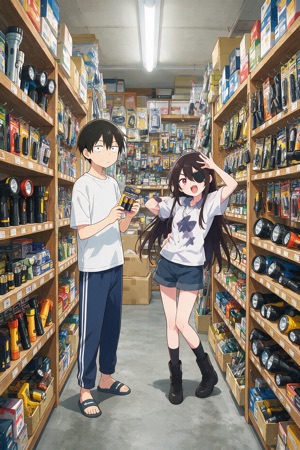
When we get to my apartment, Rikka drops her bag on the floor, opens the drawer, and pulls out the eyepatch. It’s still there, folded neatly, the fabric slightly worn at the edges. She holds it up, looks at it, and then at me. “Do you miss it?” she asks, half-serious, half-teasing. I shrug, because I’m not sure how to answer a question that feels like a ripple in a pond that’s otherwise still. “Sometimes,” I say, “but I think I’m okay with it being… there.”
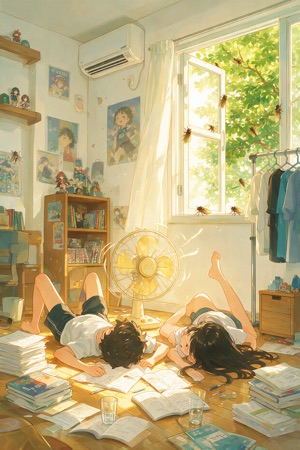
We spend the afternoon doing the usual chores. I wash the dishes while she folds laundry, the rhythm of water and the soft rustle of fabric filling the room. The TV is on, a sitcom playing in the background, jokes landing in a way that makes us both laugh, but the laughter feels a little mechanical, like we’re following a script we’ve heard a hundred times. It’s pleasant, it’s safe, it’s normal.
Evening rolls around, and Rikka makes dinner—a simple stir-fry with vegetables and tofu. The scent fills the kitchen, and for a moment the air feels thick with nostalgia, like the smell of incense from the shrine we used to visit on our imaginary quests. We eat at the small table, the plates clinking, the conversation drifting from school assignments to the weather. “Did you see the meteor shower last night?” I ask, half hoping she’ll remember the night we chased stars with a cloth. She shakes her head, eyes soft, and says, “No, but I heard it was beautiful.” I smile, because the answer is both true and not.
After dinner, we settle on the couch. Rikka pulls a blanket over us, and we watch a movie that we’ve both seen a dozen times. The plot unfolds, the jokes land, the emotional beats hit. I glance at her, notice the way her eyes crinkle at the corners when she laughs, and feel a tug at something I can’t quite name. It’s not sadness, not really; it’s more like a gentle ache, a reminder that something once vibrant has settled into the background.
The next morning, the routine repeats. I wake, I brush my teeth, I stare at the mirror and catch a glimpse of the eyepatch lying on the dresser, as if it’s waiting for me to pick it up. I don’t. I go downstairs, and Rikka is already at the table, reading a book. She looks up, smiles, and says, “Morning.” The word feels like a ritual now, a small incantation that keeps the day moving.
School is the same. The teachers are the same. The chalkboards are the same. I notice a new poster in the hallway advertising a club meeting—something about a “Literature Club” that meets after school. I think about joining, but the idea feels like a side quest I’m not ready to take. I tell Rikka, and she shrugs, “If you want to, go for it.” Her support is genuine, even if the suggestion feels like a gentle nudge toward something unfamiliar.
After school, we walk home again, but this time the sky is overcast. The clouds hang low, a gray blanket over the city. Rikka looks up, sighs, and says, “It’s like the world is taking a day off.” I nod, because the metaphor fits. The walk feels slower, each step a little heavier, as if the weight of the clouds is pressing down on our shoulders.
We get home, and Nibutani is in the kitchen, preparing tea. She looks up as we enter, eyes bright, and says, “Good to see you both back so early.” Her voice is warm, the same tone that used to coax us into our nightly rituals of storytelling. She sets two cups on the table, pours the tea, and sits down with us. The steam rises, curling like the smoke from the candles we once used in our imaginary ceremonies.
We chat about the day—Rikka mentions a math problem she solved, I talk about a funny incident in class where the teacher’s marker exploded. Nibutani listens, nods, and then, after a pause, she says, “You know, it’s… normal, isn’t it?” She looks at us, eyes flickering between us, as if she’s trying to gauge whether we’ll notice the weight of the word.
The word hangs in the air, a single syllable that feels oddly heavy. “Normal,” she repeats, a small smile tugging at her lips. “We’ve all settled into it, haven’t we?” Her gaze lands on the drawer, where the eyepatch still sits, a silent sentinel.
I feel something shift, a small crack in the surface of the day. I glance at Rikka, who meets my eyes for a brief moment, and I see the same faint flicker of something—maybe nostalgia, maybe curiosity—glinting behind her usual calm. I clear my throat, and say, “Yeah, we have.” My voice sounds flat, as if I’m reciting a line from a script. I can’t help but wonder if the word “normal” is a shield, a way to keep the absurdity at bay, to pretend that the world hasn’t changed since we last chased stars with a piece of cloth.
We finish our tea, the cups empty, the silence filling the room in a comfortable way. Nibutani stands, wipes her hands on a towel, and says, “Well, I’m off to the garden. You two enjoy your… normal day.” She walks away, the soft click of the door echoing down the hallway.
The rest of the evening passes in a blur of ordinary tasks. I wash dishes, I fold laundry, I clean the living room. Rikka reads a manga on the couch, her eyes scanning the panels with a practiced ease. Occasionally, she looks up, catches me glancing at the drawer, and raises an eyebrow, as if to say, “What are you thinking?” I shrug, smile, and say, “Just wondering about the universe.” She chuckles, a soft sound that makes the room feel a little less empty.
Later, we sit on the balcony, the city lights blinking like distant fireflies. The night is cool, a gentle breeze rustling the leaves of the potted plants. I pull the eyepatch out of the drawer, hold it between my fingers, feeling the texture of the fabric, the faint scent of dust that has settled over it. I turn it over, looking at the small embroidered symbol—a stylized eye, an abstract representation of something larger, something we once believed could change the world.
Rikka leans against the railing, her shoulders relaxed. “Do you ever think about… the Contract?” she asks, voice low. The Contract of the Wicked Eye, a phrase that used to sound like a promise of power, now feels like a memory tucked away in the back of a drawer. I look at her, see the seriousness in her eyes, and realize that even though we’re living a life that feels normal, the undercurrent of that old promise still runs beneath the surface.
I smile, and say, “Sometimes. But maybe it’s okay to let it rest.” She nods, and for a moment we both stare at the city below, the lights flickering like a galaxy we once tried to map with a piece of cloth. The silence stretches, not empty but filled with the unspoken understanding that we’ve grown, that we’ve let some parts of ourselves settle into the ordinary, and that perhaps that’s what it means to keep a drawer open.
The night deepens, the stars above us appear as tiny pinpricks in the sky, distant and indifferent. I think about the week that has passed, the small moments that have felt both comforting and a little hollow, the way Nibutani’s word “normal” echoed in the kitchen. I realize that the ordinary can be a kind of magic too—quiet, steady, a rhythm that carries us forward even when the grand gestures have faded.
I turn back to the apartment, the lights warm and inviting. Rikka is still on the balcony, her silhouette framed against the cityscape. I walk over, sit beside her, and we sit in companionable quiet. The eyepatch rests on the table, a reminder that the world we once imagined still exists somewhere, tucked away in the corners of our minds.
We don’t need to say anything more. The night is full of unspoken promises, of a tenderness that underlies our deadpan jokes, of a gentle acceptance that we’re living a life that’s both ordinary and extraordinary in its own quiet way. The week goes on, each day a repeat of the last, each moment a brushstroke on the canvas of our lives, the unnamed feeling humming softly in the background, a reminder that we never truly leave behind the things that saved us.

The app remembers where you stopped, reads chapters aloud, and works offline. Writing lives there too.