Home
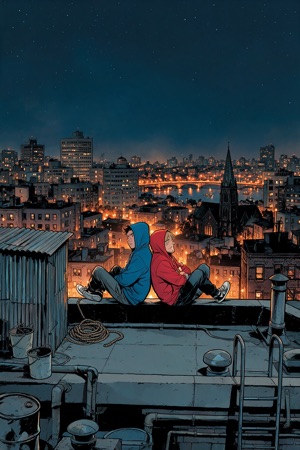
The night stretched out like a cheap blanket—thin, rattling at the edges, but somehow holding the city’s heat in place. Wade slipped the roof hatch open with a sigh that sounded more like a laugh, and the city’s neon pulse seeped up through the metal, tickling his ears. He could already feel the weight of the building’s sighs, the way the concrete breathed when the garbage trucks rumbled past, and the occasional bark of a stray mutt that thought the rooftop was a personal stadium. (He had a habit of anthropomorphizing brick and steel; it made the endless vigil less lonely, even if it made him sound like a bedtime story gone wrong.)
He paused, glancing down at the hallway where Peter’s door stood ajar, a thin sliver of warm light spilling onto the scuffed linoleum. The scent of simmering sauce drifted up—a promise that someone was still cooking, still caring, still trying to make a normal dinner out of a universe that kept throwing alien tech and super-villain drama at them. Wade’s stomach gave a small, involuntary chortle. “You know, if I had a nickel for every time a stew saved the world, I’d finally be able to afford a proper couch,” he muttered, the words bouncing off the metal beams like a stray bullet.
A soft “Hey, you’re still up?” pinged on his phone. He flicked it open, the screen flashing Peter’s name, and a barrage of emojis—pizza slice, heart, a tiny spider wearing sunglasses—filled the screen. “Yeah, just doing the usual ‘fight crime while my roommate pretends he’s not terrified of me’ routine,” Wade typed back, his fingers dancing with the frantic rhythm of someone who’d spent the last hour sprinting up and down rooftops, ducking under power lines, and stepping over a half-eaten bagel that a late-night jogger had dropped. He added a parentheses-laden joke at the end, because he knew Peter loved those: (If you need a break, I’ll bring the cat down for a cuddle; he’s already claimed the curtains as his personal jungle gym, but he’ll settle for a warm lap.)
The reply came instant, a string of quick-type sarcasm that only Peter could master: “Sure, bring the cat. I’ll be here, trying to keep the rent from evaporating into thin air while you’re out being a flying, web-slinging, tank-treading superhero. Also, the pizza’s on its way, but if you’re not back by 2 a.m. I’m ordering ramen. You know how you always say ramen is the food of the gods, right?”
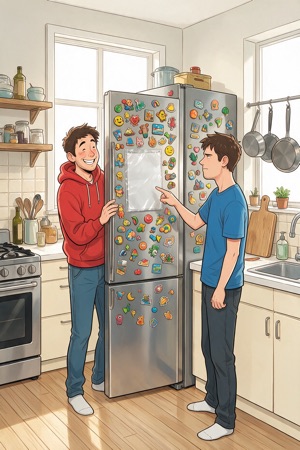
Wade laughed, a sound that was part snort, part bark, and part the low hum of a city that never truly slept. He imagined Peter at the kitchen counter, measuring out rice with the precision of a chemist, while the cat—Captain Purr-fect—watched from atop the fridge, tail flicking like a metronome. (If the cat ever learns to open the fridge, Wade’s life will be officially over.)
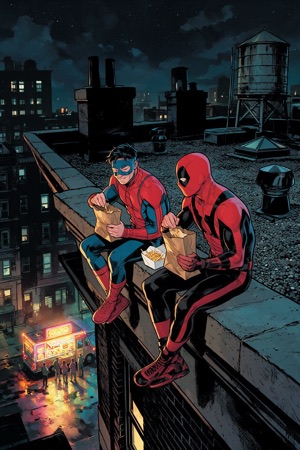
He lifted off the roof, the wind tugging at his suit like an overexcited toddler. The city’s lights flickered beneath him, each one a tiny star in a sky that was really just a grid of neon signs and billboard ads. He swung from a fire escape, the metal groaning under his weight, and landed on the street with a soft thud that sounded suspiciously like a whispered apology to the concrete. The night was already full of its own soundtrack: sirens wailing in the distance, a distant saxophone playing a melancholy blues riff, and the occasional honk of a taxi driver who seemed determined to be heard over the hum of traffic.
A scream sliced through the night, sharp as a knife. Wade’s senses snapped to attention, his muscles coiled like a spring. He turned, his eyes scanning the alleyway where the sound seemed to originate. A figure hunched over a trash can, cradling something that looked like a broken neon sign, while a group of teenagers loitered nearby, laughing and throwing empty soda cans like they were confetti. “Yo, you okay?” one of them called, barely looking up.
Wade’s mind ran a quick inventory: spider-sense tingling, adrenaline surging, the fact that Peter probably just put the kettle on and was waiting for him to come home. He stepped forward, the night swallowing his movement, and the teen’s voice faded into a low, nervous murmur. The figure—a woman in a hoodie—looked up, eyes wide, and the broken neon flickered weakly, casting a sickly orange glow on her face. “I… I think I dropped my phone,” she stammered, holding up a cracked screen that still displayed a half-finished text: “Hey—”
He crouched, his hand hovering over the device, then over the woman’s shoulder. “What’s the deal, lady?” he asked, his tone a mix of concern and the kind of sarcasm that could disarm a supervillain. She blinked, confused, as if his voice had turned the night into a sitcom. “I… I was trying to take a picture of the bodega’s sign. It’s… it’s my dad’s old shop. He… he used to work there. I—”
Her words trailed off, and Wade felt the sudden weight of something he hadn’t expected—a genuine tug at his chest, like the way a stray cat might settle on your lap when you’re trying not to notice it. He didn’t have to say anything; the moment was already saturated with a quiet, unspoken understanding. He handed her the phone, his fingers brushing hers for a split second, and the contact sent a jolt through his own nerves.
“You’re welcome,” he said, the words slipping out softer than his usual bravado. The woman nodded, a tear glistening at the corner of her eye, and then she turned, disappearing back into the night with the broken neon sign in hand. Wade watched her go, feeling the city’s pulse sync with his own—steady, relentless, oddly comforting.
He turned back toward the bodega, his mind already cataloguing the laundry list of things he needed to check: the busted fire alarm, the leaky faucet in the bathroom, the mysterious smell that seemed to emanate from under the couch (it was probably just Peter’s old socks, but Wade liked to imagine it was something more exotic). He thought about the cat, about the pizza, about the ramen, about how the world could be a chaotic mess of explosions and spider-webbed villains and yet still find room for a quiet evening in a tiny Queens apartment.
The stairwell was dark, the only light coming from the flickering bulb overhead, which sputtered like a dying firefly. He paused at the landing, listening to the faint hum of the refrigerator, the distant clatter of dishes from the kitchen, and the soft purr of Captain Purr-perfect as the cat settled on the windowsill, eyes half-closed, tail flicking in a lazy rhythm. (If the cat could talk, Wade imagined it would say something like, “You’re late, human. I’ve been waiting to knock over the vase again.”)
Peter’s voice floated up the hallway, low and weary, as he lifted the lid of a pot, the steam curling around the ceiling like a ghost. “Hey, you’re back early,” he called, the tone teasing but edged with exhaustion. “I figured you’d be out hunting something that’s probably just a raccoon in a cape.”
Wade leaned against the wall, his back to the cold metal, and smiled. “Raccoon in a cape, sure. But I also saved a lady’s dad’s memory, and that’s gotta count for something.”
Peter chuckled, the sound a little raspier than usual. “Everything’s a count when you’ve got a broken neon sign and a cat that thinks curtains are jungle gyms. Come on, the pizza’s in the oven, and I’ve got ramen in the freezer. You want to be the hero who saves the night and then collapses on the couch with a bowl of noodles?”
Wade rolled his eyes, the kind of exaggerated gesture that was both playful and genuine. “Only if you promise not to start a debate about whether ramen is a soup or a salad,” he replied, the sarcasm landing like a gentle punch. The cat, hearing the word “pasta,” leapt off the windowsill with the grace of a miniature tiger, landing squarely on the couch and giving Wade a look that said, “You’re not getting the seat.”
Peter shook his head, a smile tugging at his lips. “Fine, you win. Let’s eat.” He turned the oven knob, the timer ticking down, a soft beep promising a hot, cheesy slice of redemption. The room filled with a familiar, comforting scent—marinara, melted mozzarella, the promise that somewhere, amidst the chaos of swinging between skyscrapers and dodging super-villains, there could be a simple, ordinary moment that felt like a soft blanket.
Wade sank into the couch, the cushion sighing under his weight, the cat immediately jumping onto his lap, kneading his shirt with a rhythm that matched the thrum of the city outside. He felt the heat of the pizza radiating through the cardboard box, the steam curling up and mingling with the faint scent of the night’s rain, and for a split second, the world seemed to hold its breath.
Peter set the plates down on the coffee table, a stack of takeout containers that looked like tiny forts. “You know,” he said, his voice softer now, “I used to think being a hero was about the big moments—saving the city, stopping the apocalypse, all that. But tonight, it’s about this. About a burnt crust, a cat that thinks it owns the couch, and a guy who can’t decide if he wants to swing from a web or just stay in his pajamas and watch Netflix.”
Wade glanced at the cat, who was now purring like a tiny engine. The cat’s eyes were half-closed, content, as if it knew that this was the ultimate victory: a warm apartment above a bodega, a roof that had seen the city’s scars, a kitchen that smelled like home, and a roommate who could turn a night patrol into a joke and still be there when the lights went out. He looked at Peter, at the familiar lines on his face, at the way his hair stuck out from under the visor of his mask like a wild halo, and felt something shift inside him—a quiet realization that the chaos outside was just background noise to the symphony happening right here.
He took a bite of the pizza, the cheese stretching like a promise, the sauce tangy and sweet, and the cat’s purr grew louder, vibrating through his chest. “You know what I love about this place?” Wade said, the words slipping out half-joking, half-serious, “It’s the only spot where I can swing from a web, drop a neon sign, and still come home to a bowl of ramen that doesn’t judge me for being a mess.”
Peter laughed, a deep, genuine laugh that made the apartment feel larger than its square footage. “And the only place where a cat can be a jungle gym and a therapist at the same time.”
They ate in comfortable silence, the kind that only two people who have survived the apocalypse of their own making can share, the cat curling tighter around Wade’s legs, the city humming outside like a lullaby for the weary. The night stretched on, the stars above the rooftop flickering like tiny lights in a sky that seemed less hostile when you had a place to return to—a place that smelled of pizza, ramen, and the faint, comforting musk of a shared life.
When the last slice was gone, and the ramen bowl was empty save for a few stray noodles clinging to the sides, Wade leaned back, his shoulders finally relaxing after a night of endless motion. He felt the weight of the world lift, replaced by something lighter, softer, more tangible: the warmth of an apartment that had become a sanctuary, the steady rhythm of a cat’s purr, the quiet glow of a lamp that didn’t flicker, the knowledge that even in the most unglamorous corners of Queens, love could be found in stews, pizza, and the simple act of being together. The apartment above the bodega wasn’t just a roof over their heads; it was the thing that made everything else survivable, the quiet, warm, unremarkable miracle that turned a rough night into home.

The app remembers where you stopped, reads chapters aloud, and works offline. Writing lives there too.