- Stories
- Contemporary
- The Understudy
- The Second Night
The Second Night
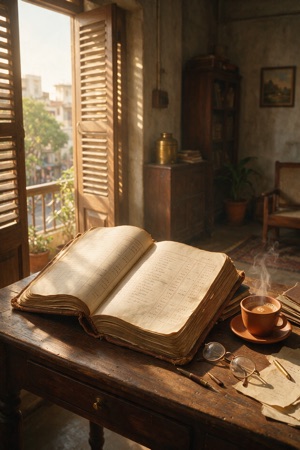
She rose before dawn, the alarm’s tinny buzz cutting through the thin night air. The ceiling fan still whispered, its blades moving sluggishly in the humidity. She slipped on the cotton slippers, their rubber soles scuffed from the hallway of her building. The kitchen light flickered, sputtering before steadening, casting a pale halo over the chipped enamel sink. She lifted the kettle, its metal body cold, and set it on the stove. The gas flame hissed, a thin blue line that turned orange as the water swelled. She measured two teaspoons of loose Assam, the fragrant leaves spilling into the waiting pot. The kettle sang, steam curling up and fogging the cracked window pane.
The tea tasted bitter, the kind of bitterness that clung to the back of the throat and refused to fade. She sipped it slowly, feeling the heat travel down her throat, a brief respite from the chill that lingered in the early morning. She opened the notebook, the pages still slightly damp from the night’s rain, and read the line she had written: “Night ended. No revelation, only a step.” The ink had bled a little where the pen had pressed hard. She turned the page, the new sheet crisp, and began to list the items she needed for the rehearsal: a fresh set of tights, a replacement pair of shoes, a replacement costume for the second act, Rs 350 for the bus fare, and Rs 1,200 for the upcoming rent.
She placed the notebook on the small wooden table beside the door, its legs worn smooth where her hands had rested countless times. The bus stop was a five-minute walk down the lane, the potholes filled with stagnant water that reflected the orange glow of the streetlamp. She lifted the purse, the leather cracked at the corners, and counted the cash: Rs 720 in notes and coins, a small surplus that would cover the bus and a modest lunch. She closed the purse, the metal clasp clicking shut, and stepped out onto the wet pavement. The city was already waking; the scent of fried dosas mingled with diesel fumes, the sound of a distant train rattling over the tracks.
The bus arrived with a screech, its doors opening to a gust of warm air that washed over her. She paid the driver, handing over a ten-rupee note, his fingers brushing the metal as he gave her the change. She took a seat near the back, the seat cushion sagging under the weight of previous passengers. The route took her past the familiar sight of the theatre’s iron gate, its paint flaking, the marquee still bearing the name “Kural Manam” in faded letters. She stared at it, remembering the night before, the way the director had gestured toward the stage, the way the audience’s applause had trembled in the air, a sound she could still hear when she closed her eyes.
The theatre’s lobby was dim, the marble floor polished to a dull sheen. She set her bag on a bench, its wood scarred from years of use, and slipped into the dressing room. Rupa was already there, seated on the cracked plastic chair, her hair pulled back into a tight bun, a cup of tea steaming beside her. The room smelled of talc and sweat, the mirror above the vanity reflected two women in the same fluorescent light. Rupa glanced up, her eyes sharp, a thin smile forming at the corners of her mouth.
“Morning,” Lakshmi said, her voice low, the word barely carrying over the rustle of fabric as she removed her coat.
Rupa’s smile widened. “You slept well?” she asked, her tone casual but her gaze probing. “You looked pale yesterday, like you had been holding your breath all night.”
Lakshmi took a seat opposite her, laying her notebook on the table. The pages fluttered in the draft from the open window, a thin sheet of paper turning over itself. “I wrote a line,” she said. “It felt like a map.”
Rupa lifted the cup, taking a sip. “Maps are useful,” she said. “They tell you where you are, but they don’t tell you where you want to go.” She set the cup down, the clink echoing in the small room. “You’ve been onstage. You’ve felt the lights on your skin, the weight of the audience’s gaze. Do you want more of that?”
Lakshmi stared at the script on the table, the pages marked with red lines, the dialogue of her character, Priya, highlighted in yellow. She traced the ink with her fingertip, feeling the texture of the paper, the slight unevenness of the print. “I want to be seen,” she said, the words simple, the intent complex.
Rupa’s eyes narrowed. “Seen by whom?” she asked. “By the director? By the critics? By the people who buy tickets and then leave before the curtain falls?”
Lakshmi thought of the bus fare, of the rent, of the money she earned from the part-time clerical job at the publishing house, the Rs 5,000 she received every month, the Rs 2,500 she sent to her mother for medicine. She thought of the unpaid overtime, the extra rehearsals, the evenings spent polishing shoes that never seemed to shine. She thought of the applause, a brief surge of warmth that faded quickly, leaving only the echo of the curtain’s rustle.
Rupa leaned forward, her elbows on the table. “There is a difference between wanting something and being owed it,” she said. “Your place in this company is not a right. It is a concession, a grant that can be taken away the next night.”
Lakshmi’s throat tightened. She swallowed, the tea’s bitterness returning. “I know,” she said. “I just… I thought I could make it.”
Rupa’s gaze softened for a moment, then hardened again. “You can make it if you are willing to pay the price. Not the money, but the cost of being invisible when you are not onstage, the cost of rehearsing lines you will never deliver, the cost of watching others take the spotlight while you stand in the wings, holding a script that will never be yours.”
She stood, the chair squeaking, and walked to the small cupboard, pulling out a worn leather satchel. She placed a folded piece of paper inside, the edges frayed. “I have an offer,” she said, handing it to Lakshmi. “A teaching position at the community centre. Two classes a week, Rs 8,000 a month. No applause, no lights, but steady pay, a schedule that lets you keep your other job. It’s not theatre, but it is work.”
Lakshmi opened the paper, the words printed in a plain font, the details of the contract clear: days, times, duties, salary, responsibilities. She traced the line about “minimum commitment of six months,” the clause about “no engagement with external performance groups without prior approval.” She felt the weight of the paper, the ink slightly smudged where she had pressed her thumb against it.
She looked up at Rupa, the woman who had once been her mentor, the woman who had guided her through the first lines of Priya’s monologue, the woman who had stood beside her when the director had whispered “understudy” into the dark. “What if I stay?” Lakshmi asked. “What if I keep trying for the lead?”
Rupa’s expression was unreadable for a heartbeat, then she smiled, a thin line that seemed almost pity. “Then you will keep rehearsing the same breath, the same posture, the same disappointment. You will keep living on the edge of a stage you never cross. You will keep telling yourself that the next night will be different, and it will not be.”
Lakshmi felt the knot in her chest loosen, not because the words were comforting, but because they cut through the fog of her ambition. She looked at the notebook on the table, at the page where she had written about the director’s kindness, the city’s indifferent lights, the bitter tea. She realized the line she had stretched across the page was not a promise, but a description of a moment she could no longer pretend was anything more.
She stood, the chair scraping the wooden floor, and walked to the window. The street below was quiet, the rain having stopped, leaving a sheen on the pavement that reflected the pale sunrise. She could hear a vendor setting up a stall, the clatter of metal pans, the distant honk of a car. She thought of the Rs 720 in her purse, of the rent due on the fifth, of the bills waiting in her inbox. She thought of the steady rhythm of a teaching schedule, of the quiet satisfaction of a class that listened, of the small gratitude of a child who finally understood a poem.
She turned back to Rupa, who watched her with a mixture of curiosity and resignation. “I will take the job,” Lakshmi said, her voice even. “I will teach. I will keep the theatre as a hobby, not a career.”
Rupa nodded, the movement slow, as if confirming a decision she had already made for both of them. “You will still be here,” she said, gesturing toward the stage door that led to the darkened auditorium. “You will still have the script, the costume, the chance to walk onto the boards when they need you. You will still have the possibility of a line, a moment, a breath that belongs to you. That is enough.”
Lakshmi felt a small, unexpected relief settle in her chest, a quiet gratitude that was not loud enough to be a triumph, but enough to make her shoulders less tense. She picked up the satchel, the leather soft under her fingers, and placed the folded contract inside. She slipped it into her bag, the weight of it a reminder of the choice she had made.
She left the dressing room, the hallway lights humming above, the scent of talc still lingering. She passed the empty stage, the wooden boards polished, the spotlights dark. She paused for a moment, the silence pressing against her ears, and then continued down the corridor, her shoes clicking against the concrete floor. She emerged onto the street, the morning light bathing the city in a pale gold, the rain leaving puddles that mirrored the sky.
She walked to the community centre, the building modest, its walls painted a faded teal, a sign above the door reading “Shanti Community Hub.” Inside, the room was empty, chairs stacked, a whiteboard waiting for chalk. She imagined herself standing at the front, a simple lesson on Shakespeare’s sonnets, the children’s eyes bright as they tried to grasp the rhythm. She saw herself, not under the glare of a stage light, but under the steady glow of a fluorescent tube, her voice carrying across a room that would not applaud but would listen.
She thought of the Rs 8,000, of the stability it would bring, of the rent paid without panic, of the meals she could afford without rationing. She thought of the evenings she would still spend rehearsing, of the occasional call from the director asking for a replacement, of the rare chance to step onto the stage when the lead fell ill. She felt a small, steady pulse in her chest, a quiet acknowledgment that ambition was a line she could walk, but not a promise she could claim, and that she had chosen a path that was not glamorous but was hers.
She entered the centre, the door closing behind her with a soft click. The room was quiet, the air smelling faintly of disinfectant and fresh paint. She set her bag down, opened the notebook, and wrote a single line: “I chose the second night, the steady breath of a classroom, the unadorned grace of a quiet life.” She paused, the pen resting on the paper, and felt a thin smile form on her lips, as if the world had offered her a modest gift, and she had accepted it without fanfare.

The app remembers where you stopped, reads chapters aloud, and works offline. Writing lives there too.