The Third Tape
The night has already slipped into a kind of amber, the kind you see on old photographs when the sun has gone down and the streetlamps are the only things that glow. I sit in the chair behind the desk, the little lamp on my left casting a thin halo on the stack of tapes. The clock on the wall ticks past 2:30 a am, each movement a soft click that seems louder than it should be. I can hear the hum of the transmitter, the faint whine of the cooling fan in the back of the console. The studio is a small, insulated box, and the world beyond its walls feels like a story I’m not supposed to hear.
I have the third tape in my hand. The label is a smudge of ink, the date handwritten in a hurried hand. I know the rules: I am not to trace the source of a call that comes from a private line, especially not one that comes with a confession. The station’s policy is clear. But the voice on the tape is not a stranger’s; it feels like a mirror, a broken piece of my own reflection. It is the same low tone, the same pause after every sentence, the way the breath catches at the end of a word as if the speaker is holding something back.
I push the tape into the player, the metal gears grinding as the reels begin to turn. The voice starts, brittle, almost reverent. “You said you wanted to hear the truth, Marnie,” it says. The words are not new; they echo the first call, the second, the third. I listen as the speaker walks through a house, describing the creak of floorboards, the smell of old wood, the way the light falls through a cracked window. He describes a kitchen table, a photograph on the wall, a name written in a child’s hand. He does not name the place, but the details are precise enough to paint a picture in my mind.
The voice stops before he says the name. The silence that follows is heavier than any scream. I feel the tape’s magnetic pull, the way the tape is wound tight around the reels, as if the recorder itself is holding a breath. I press stop, the motor grinding to a halt. The air in the room feels colder now, as if the studio has inhaled the night and is holding it.
I cannot let it go. The rules are meant to keep us safe, to keep us from getting tangled in something we cannot control. The voice on the tape is a thread I have pulled, and it is fraying. I know the number the call came from, a block of digits that, when entered into the station’s trace system, will show a location a few miles north of here, in a place where the road ends in a field of tall corn. The system is meant for emergencies, for threats. I am not a police officer. I am a host, a voice in the dark.
But the calm that usually steadies me has cracked. I feel the small tremor in my chest, the way my fingers tighten around the edge of the desk. I decide to step outside, to follow the line of a call that has become a line in my own story.
I pull the tape from the player, slip it into the pocket of my coat, and walk out into the hallway. The studio door sighs shut behind me, the latch clicking with a metallic finality. The hallway is dim, the fluorescent lights flickering. I walk past the break room, past the rows of empty chairs, and out onto the concrete slab that is the station’s parking lot. The air is thick with the smell of wet asphalt, a faint hint of diesel from the trucks that pass by at odd hours. The sky is a deep indigo, the stars pinpricks of cold light.
I slide into the driver’s seat of my old sedan, the engine humming to life. The radio is off. I pull the number into the navigation system, the small screen flashing a red dot on a road that disappears into a swath of cornfields. I drive, the tires cutting through the dewy grass, the sound of the engine a low thrum that fills the quiet. The road is straight, the fields on either side a sea of green that seems to sway in a rhythm I can’t hear. The sky is a ceiling of darkness, the only illumination coming from the weak glow of my dashboard.
At a certain mile marker, the road narrows, the pavement turning to gravel. The sound of the tires on the stones is a soft crunch, a reminder that I am leaving the world of concrete and stepping into something older. The radio static in my mind is replaced by the whisper of wind through the corn, a soft rustle that sounds like a sigh. I drive on, the headlights cutting a thin line through the night.
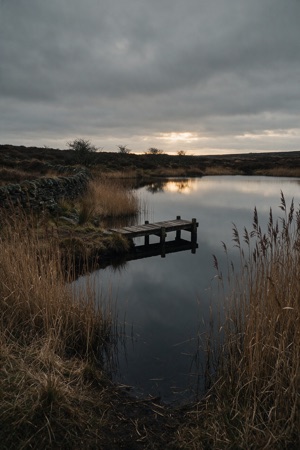
The address that the trace shows is a house, an old farmhouse that looks as if it has been waiting for someone to notice it for decades. It sits at the edge of the field, its paint peeled, its porch sagging under the weight of time. A single porch light flickers, casting a trembling glow onto the porch steps. I pull up, the engine turning off with a sigh. The silence that follows is the same as the studio’s after a call ends, a quiet that feels like a held breath.
I sit in the car for a moment, the night air cooling the skin on my cheeks. The house looks like a memory, a place that exists more in the mind than in reality. I think about the voice on the tape, about the way it described a kitchen table, a photograph, a name in a child’s hand. The house in front of me seems to match that description. The porch has a small table with a chipped mug, the window across the porch has a curtain drawn back just enough to reveal a faded photograph hanging near the sill. I step out, the gravel crunching under my boots, the cold biting my feet.
The front door is unlocked, the wood swollen from years of rain. I push it open, the hinges groaning in protest. The hallway inside is dim, the air smelling of dust, of old wood, of something faintly sweet, like the lingering scent of lavender that has long since faded. I move forward, my hand brushing against the wall, feeling the uneven plaster, the dents where pictures once hung. The house is quiet, the only sound the faint ticking of a clock somewhere deeper inside, a rhythm that matches the one I heard on the tape.
I follow the hallway to the kitchen. The room is small, the floorboards warped, a single bulb hanging from the ceiling, its light yellowed and weak. The table is the same as the one described, a scarred wooden surface with a set of mismatched chairs. On the table lies a photograph, its frame cracked, the image blackened at the edges. I lean in, the picture is of a young girl, perhaps ten years old, her hair in pigtails, her eyes bright, a smile that seems to hold a secret. Beside the photograph is a small notebook, its pages yellowed, the ink faded.
I open the notebook, the pages whispering as I turn them. The handwriting is cramped, the letters slanting, as if written in haste. The first entry reads, “April 3. She asked me to keep it safe. I promised.” The entries continue, each a line or two, describing daily routines, small moments, a mother’s voice, a father’s absence. The final entry is dated July 12. “I can’t say it here. I can’t say it anywhere. I’m sorry.”
The words settle on me like a weight. The voice on the tape, the description of the house, the photograph, the notebook—they all point to a single, quiet tragedy. I feel the room close in, the quiet becoming a pressure against my ears. I realize that the caller is not a murderer. He is a son, perhaps, holding a secret that he cannot speak aloud. The “killing” he described is not a violent act; it is the death of a child, the loss of a mother’s love, a family that fell apart in a way that could not be spoken in the daylight.
I hear a floorboard creak behind me. I turn, the light from the bulb flickering, and see a figure standing in the doorway, a woman, her back to me. She is old, her hair pulled back into a bun, a shawl wrapped around her shoulders. She does not speak, but her eyes are fixed on the notebook in my hands. She steps forward, the sound of her shoes muffled by the carpet. She places a hand on my arm, the touch cold but steady.
“Did you hear them?” she asks, her voice low, each syllable a breath caught in the night.
I shake my head, the words caught in my throat. “Who?”
She looks at the photograph, at the notebook, at the empty chair across the table. “Your voice,” she says, “the one that knows the way to listen. You heard what we could not say. You heard the sound of a heart breaking, not a heart beating.”
I feel my own breath shallow, the room’s air heavy with a sorrow I cannot name. The woman moves to the table, picks up the photograph, and holds it to the light. “She was my daughter,” she says, the words slipping out like a whisper. “She died on a night like this. I never told anyone. The police came, they asked, they looked for signs. There were none. I could not speak. I called you because your voice was the only one that could hold the silence.”
She folds the notebook, the pages soft as skin, and places it on the table. “Keep it,” she says. “It is not a confession of murder. It is a confession of love that could not be spoken. The tape you have, the story you have, it is not about a killer. It is about a mother’s grief, a son’s guilt, a family’s fracture. The world will never understand the weight of that silence, but you can hear it. You can carry it.”
I watch her walk back to the doorway, the light catching the silver strands in her hair. She turns, the silhouette of her figure framed by the dark outside, and she is gone. The house feels empty again, the only sound the ticking of the clock, the faint rustle of corn in the wind outside. I stand there, the notebook in my hand, the weight of it solid and real.
I return to the car, the night still deep, the stars indifferent. I sit in the driver’s seat, the engine off, the darkness pressing against the windows. I think about the tape in my pocket, the voice that asked for truth. I think about the rules I broke, the line I crossed. The horror is not in the murder I imagined, but in the truth that is held in quiet places, in the things people cannot say to anyone but a stranger in the dark.
I turn the key, the engine humming to life, the car moving forward into the night. The road stretches ahead, the corn whispering, the house receding into a silhouette. I feel the weight of the notebook in my lap, the photograph’s image lingering in my mind. I know the next broadcast will be different. I will not tell the audience a story of a serial killer; I will tell them of a grief that could not be spoken, of a voice that finally found a place to be heard.
The night is still, the air still, but inside the studio, the tape will spin again, and this time, the words will be softer, the dread quieter, the truth a sigh that drifts through the dead air.

The app remembers where you stopped, reads chapters aloud, and works offline. Writing lives there too.