May
The night before the battle, Bridie had already begun the sort of inventory that made the rest of the castle feel as if it were being measured in spoonfuls and sighs. She had taken the old copper kettle from the pantry, filled it with water, and left it simmering over a low flame, the steam curling up like a quiet accusation. She had spoken to the younger girls in the dormitory about keeping their heads down, about how a well-timed cough could be louder than a spell, and she had slipped an extra piece of bread into the pocket of a boy whose eyes were too bright for the gloom.
When the first echo of shattering stone rolled through the corridors at dawn, Bridie was already in the back passage that ran behind the kitchens, the one that had been forgotten when the castle was first built and that now served as the most reliable route for anyone who needed to move unseen. She felt the vibration through the floorboards, a low hum that grew louder with each passing moment, like a kettle about to boil over.
She did not look up at the ceiling where the tapestries fluttered, nor did she linger at the doorway that opened onto the Great Hall. Her gaze stayed low, fixed on the line of copper pots that marked the edge of the corridor. The first clatter of a falling stone sent a cascade of copper into a metallic chorus. She bent, lifted a pot with practiced ease, and set it aside, the clang a brief punctuation in the growing din.
A boy, his robes stained with mud and blood, stumbled into the passage, clutching a wounded hand. His face was a mess of sweat and fear, the Gryffindor scar faintly visible beneath the mess of hair that fell into his eyes. He tried to speak, but the words caught in his throat.
“—got any—” he rasped, and Bridie understood without the need for a full sentence. She lifted a clean handkerchief from the drawer beside the stove, pressed it against his wound, and whispered, “Keep it low, love. We’re not out of here yet.”
He nodded, eyes flickering to the darkness beyond the doorway. She guided him toward the pantry, where a hidden shelf held a small supply of ointments and bandages she had secretly collected over the months. The boy’s hand trembled as he took the bandage, his fingers brushing against the coarse wool of the pantry curtains. Bridie watched the way his shoulders sank, the tension easing by a fraction.
The corridor filled with a procession of students and staff, each moving as if through a river of stone. A teacher, her hair a wild tangle, clutched a tray of soup, the steam rising like a beacon. She shouted over the roar, “Anyone needs a spoon? Keep your head down, and we’ll get you out before they see us!” Her voice was dry, edged with the kind of humour that could cut through panic.
Bridie handed out spoons, ladles, and the occasional slice of buttered bread, the small acts of kindness that felt more like a calculation than a gesture. She counted as she passed each person, the numbers forming a rhythm in her head: twenty-three, twenty-four, twenty-five. She had learned early that numbers were safer than promises; they could be checked, recounted, adjusted if necessary. She did not speak of the fear that lingered at the back of her throat; she simply kept the line moving, a quiet conduit between the chaos beyond and the safety she could still muster within.
A sudden crash reverberated down the corridor, the stone wall near the old laundry caving in. Dust rained down like a thin veil, and for a heartbeat the world went gray. When the dust settled, a group of younger students huddled together, eyes wide, clutching each other’s robes. One of them, a seventh-year boy with a scar on his cheek, whispered, “Is it… is it the end?” His voice cracked, the question hanging in the stale air.
Bridie crouched, her knees scraping the cold stone, and placed a firm hand on his shoulder. “It’s the end of the night, not the end of the war,” she said, the dry humor in her tone a thin shield. “And the night’s over when we get back to the kitchen and finish the stew.” She gave him a small, steady smile that did not reach her eyes but was enough to give the boy something to hold onto.
The passage began to fill with the smell of smoke, a sharp, acrid sting that made her throat tighten. She could taste the iron of blood in the air, though she saw no blood—only the faint sheen on the stone floor where a stray spell had struck. The sound of distant explosions was a constant backdrop, a percussion that made the heart beat faster without any conscious effort on her part.
She slipped past a group of Slytherins, their faces hard, their eyes flicking to the shadows as if expecting something to leap out. One of them, a tall boy with a scar that reminded her of a less noble lineage, muttered, “You think you’re doing enough, Hufflepuff?” He made no move to attack, merely asked, as if the question itself were a test.
Bridie turned, the corner of her mouth lifting in a small, almost imperceptible grin. “Doing enough is a relative term,” she replied, voice low. “If we get the children out, that will be enough for now.” She walked on, her steps measured, the weight of the satchel against her hip a familiar pressure that steadied her.
The back corridor led to a service door that opened onto the lake’s edge, a narrow strip of stone that had once been used for deliveries of fresh fish. The water was black and churning, the surface broken by the occasional flash of a spell. A small boat, hidden under a tarp, bobbed gently. It had been her idea, years ago, to keep a vessel ready for emergencies. It had never been used, not until now.
She helped a handful of younger students onto the boat, their legs dangling over the side, the water lapping at their boots. A Slytherin girl, her hair tied back in a tight knot, tried to keep her composure as the boat began to sway. Bridie steadied the oars, her hands moving with a calm efficiency that had been honed over countless late-night runs through the corridors. The boat slipped away from the shore, the sound of the battle dimming behind them, replaced by the low, steady splash of oars in water.
When they reached the opposite bank, a thicket of trees offered cover. The students scattered, disappearing into the foliage, the boat left bobbing alone in the moonlit lake. Bridie turned back, her eyes scanning the horizon for any sign of movement. She saw the flicker of orange light across the stone walls, the occasional flash of a wand’s tip, the distant echo of a roar that could have been a dragon or a spell gone awry.
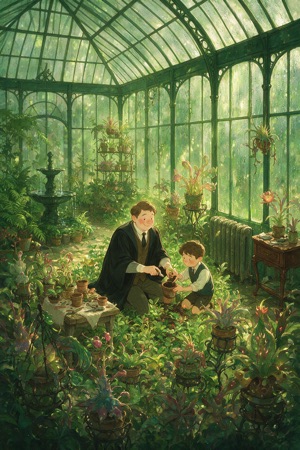
She knew the last stretch would be through the old greenhouse, a place the Carrows had turned into a makeshift infirmary. The greenhouse still held rows of glass, the broken panes reflecting the night sky like a shattered mirror. She entered, the smell of soil and wilted plants mingling with the metallic tang of magic. A handful of injured students lay on the benches, their breaths shallow, their faces pale. One of them, a boy with a mop of curly hair, clutched his arm, the wound bandaged but still oozing.
Bridie's hands moved swiftly, distributing the limited supplies she had managed to smuggle into the greenhouse. She handed out water, blankets, and a few slices of bread. She whispered, “Hold on, love. The end is nearer than you think.” Her voice was steady, her wit a thin veneer over the resolve that kept her moving.
The night grew colder, and the battle outside became a distant thunder. The greenhouse’s glass panes rattled in the wind, each impact a reminder that the castle was not yet safe. Bridie stood at the threshold, watching the fog roll in from the lake, swallowing the light, turning the world into a muffled grey. She counted the faces she had helped: one, two, three, four, five, six, seven, eight, nine, ten, eleven, twelve. She felt the fatigue settle into her bones, a dull ache that was not from the cold but from the weight of each life she had shepherded through the darkness.
When the first hints of dawn crept over the horizon, the sounds of battle faded, replaced by the soft rustle of leaves and the distant cries of birds returning to the sky. The castle's stones, scarred and smouldering, stood silent for a brief, breathless moment. Bridie stood on the threshold of the greenhouse, her coat damp with the night’s chill, her hair a mess of curls that clung to her face.
She turned to the group that had gathered, a rag-tag collection of students and staff, each bearing their own wounds, each clutching whatever comfort they could find. A girl with a broken wrist held a piece of parchment, her eyes red from lack of sleep. A boy, his hair singed, stared at the sunrise, the light catching the flecks of gold in his hair.
Bridie's fingers moved over the edge of her satchel, the leather soft from years of use. She pulled out a small notebook, the same one she had used for the ledgers, the pages now filled with names and numbers, with tiny notes scribbled in the margins. She opened it to the last page, where she had left a line unfinished: “Those who made it out—”
She counted silently, the numbers forming a rhythm she could trust. One, two, three, four, five, six, seven, eight, nine, ten. She pressed her thumb against each name, the ink slightly smudged by the night’s rain. The list was short, far shorter than she would have liked, but each name was a life she had helped to survive.
She looked up, her eyes meeting those of the boy with the curly hair, his arm still bandaged but his smile faint. “We’ve got you all,” she said, the words plain, the humour absent. “That’s what counts.” She closed the notebook with a soft thud, the leather cover giving a small, reassuring sigh.
The first rays of sun spilled over the castle’s battlements, painting the stones in a pale gold that seemed almost too gentle for what had transpired. Bridie felt the weight of the satchel shift, as if the day itself were redistributing the burden. She took a deep breath, the air crisp, tasting of wet stone and the faint sweetness of the lake.
She turned and walked back toward the kitchens, the familiar corridors now littered with the remnants of battle: broken pots, splintered wood, a few stray feathers that had once adorned a festive banquet. The fire in the hearth was still lit, its glow a small, stubborn beacon in the growing light.
As she passed the pantry doors, she caught a glimpse of a figure emerging from the shadows—a young girl, her eyes bright despite the soot on her cheeks. The girl held out a small piece of parchment, the ink still wet. Bridie took it, read the hastily scrawled words: “Thank you. We’ll remember you.”
She smiled, the kind of smile that did not reach her eyes but was enough to warm the corner of her mouth. She tucked the note into her pocket, alongside the ledger, the list of names, the small piece of paper that now bore a new inscription. She walked onward, the rhythm of her steps steady, the weight of the satchel a reminder that even in the quiet after the storm, the work continued.
She did not look back at the shattered corridors, nor did she linger on the loss that lay hidden in the stone. The castle, stubborn as ever, would rebuild. The kitchens would refill. The numbers would be tallied again, and the small acts of kindness would be measured in spoonfuls and breaths.
When she finally reached the pantry’s inner room, she paused at the doorway, the faint sound of a kettle beginning to boil behind her. She inhaled the scent of tea, the steam curling upward like a promise. She counted once more, the numbers now resting on her fingertips, a quiet testament to the lives she had shepherded through the night.
She whispered to the empty room, “Ten,” and let the word settle, a quiet affirmation that even when the world seemed to crumble, there were still ten reasons to keep the fire alight.

The app remembers where you stopped, reads chapters aloud, and works offline. Writing lives there too.