- Stories
- Fanfiction
- The Paperwork of the Sixth
- Monday: Requisitions
Monday: Requisitions
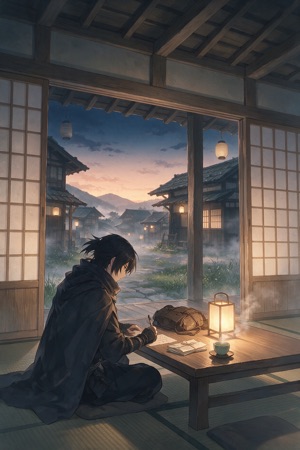
Kakashi slipped his foot into the wooden floorboards of the Hokage’s office and let the thin mat under his sandal give way to the faint scent of pine and ink. The window was still cracked open from yesterday’s rain, letting a thin line of cold wind curl across the desk. He set his cloak down, the fabric sighing as it brushed the floor, and reached for the stack of requisition forms that lay like a small mountain at the far edge of the table.
The forms were all the same: a neat box for the item, a column for quantity, a line for the department, and a space at the bottom for his signature. The ink was still wet on the first few, as if the clerk had been there just minutes ago. He lifted one, read the request for timber, and frowned. The line read “Konoha Reconstruction Division – 120 logs, 4-meter length, pine.”
He opened the ledger of the village’s supplies, the margins already smudged from the morning’s calculations. The ledger showed only 100 logs left. The numbers didn’t match, and the mismatch was already beginning to draw a line of tension across his brow. He called for the clerk.
“Shikamaru.” He said, voice even, as if the name itself could settle the arithmetic.
The lanky shinobi entered, his hands stuffed into the pockets of his coat, the familiar lazy grin tugging at his lips. He stopped short of the desk, eyes scanning the forms like a cat watching a mouse.
“What’s the problem?” Shikamaru asked, voice low, as if the walls might hear.
“The division wants more logs than we have,” Kakashi said. “We have a shortfall of twenty.”
Shikamaru shrugged. “We can pull from the forest reserve. It’s not far.”
“The reserve is being used for the new training grounds,” Kakashi replied. “We already allocated those trees to the new barracks. The schedule is tight.”
Shikamaru’s grin slipped. “So we have a conflict.”
Kakashi lifted a finger. “Yes.”
The two men stood in silence for a moment, the ticking of the old wall clock filling the space. The clock’s hands moved with a deliberate slowness that made the minutes feel like hours. Finally, Shikamaru spoke.
“Could we halve the length of each log? That would give us more pieces.”
Kakashi looked at the requisition form again. The request was for four-meter logs, because the beams needed to span the new market’s roof. Halving them would ruin the design. He thought of the market’s open plan, of the stalls that would soon be set up, of the children who would run between them. He thought of the men who had never seen those stalls.
“We can’t change the design,” he said. “The architects have signed off.”
Shikamaru tilted his head, considering. “What about the old warehouse? There are still some pine planks left there. We could repurpose.”
Kakashi frowned. “The warehouse is slated for demolition next month. The planks are needed for the temporary shelters we’re building for families who lost their homes.”
Shikamaru’s eyes narrowed. “We’re at an impasse, then.”
Kakashi’s voice stayed flat, but his mind turned over the possibilities like a stone in a stream. He could ask the reconstruction chief for a new allocation, but that would mean another meeting, another set of minutes, another line on the ledger that he would have to sign later. He could ask the village council to approve a temporary reduction in the market’s roof height, but the council would want a report, and the report would need a justification.
He lifted a hand. “I’ll talk to the chief. But you need to prepare a revised estimate. Include the cost of the extra labor needed to adjust the beams.”
Shikamaru nodded, his grin returning. “Got it. I’ll have it ready by the end of the day.”
Kakashi turned back to the pile of forms. He signed the timber requisition, his signature a simple slash across the paper, the ink drying as quickly as his thoughts. He set the form down, then opened the next file.
It was a casualty ledger, a thin book bound in worn leather. The pages were yellowed, the edges frayed from the countless times it had been opened. He lifted the cover, and the name of the village’s latest loss stared back at him in black ink.
He read the first entry: “Hiroto Yamada – Konoha Guard, died at the front line, 12th of May.” The date was still fresh, the memory of the battle still raw in his mind. He traced the name with a fingertip, feeling the weight of each letter as if it were a stone. He turned the page.
“Kiyomi Inoue – Medic, fell during the evacuation of the southern district, 13th of May.” He remembered her steady hands, her calm voice that had guided many through the smoke. He let a breath out that sounded almost like a sigh.
“Taro Saito – Builder, collapsed while reinforcing the bridge, 14th of May.” He thought of the way Taro’s laughter had echoed across the construction site, how his jokes had eased the strain of the work. He felt a knot tighten in his chest, a small, private grief that no one else could see.
“Mitsuki Harada – Apprentice, caught in the rubble of the old market, 15th of May.” He remembered the apprentice’s eager eyes, the way she had asked him once about the old stories of the village. He recalled the way her voice had quieted after the explosion.
“Ryo Tanaka – Scout, lost during the night patrol, 16th of May.” He remembered Ryo’s habit of humming quietly while he walked, the way he had always been the first to volunteer for dangerous missions.
“Ayane Fujiwara – Teacher, perished when the school collapsed, 17th of May.” He recalled how she had taught the village children to read, how she had insisted on a lesson about hope even as the walls crumbled.
The list went on. Each name a line, each line a small part of the larger emptiness that had settled over Konoha. He did not pause for each name, but his eyes lingered a fraction longer on the ones he had known. The ledger was not just a record; it was a reminder of the lives that had filled the village’s spaces, now empty.
He placed the pen on the ledger, the tip still wet with ink. He signed his name at the bottom of the page. The signature was the same as it had always been—simple, swift, unadorned. He closed the book, the leather creaking softly.
The door opened again. It was Ino, her hair tied back, a stack of documents in her arms. She stepped in, her eyes flicking to the ledger before returning to the desk.
“Morning, Kakashi-sensei,” she said, voice bright but carrying an undercurrent of fatigue. “I have the supply report for the week.”
He nodded. “Place it here.”
She set the pile down, the papers forming a small hill. He could see the numbers: food rations, medical supplies, building materials. He reached for the top sheet, his fingers brushing the top of the paper, feeling the faint ridges where ink had pressed into the fibers.
“Do we have any surplus?” he asked.
Ino glanced at the numbers, then at the ledger he had just closed. “We have a small surplus of rice. It’s enough for another week if we ration carefully.”
He allowed a small smile to cross his face. “Good. We’ll keep that in mind for the upcoming festival.”
She laughed, a short, clear sound that cut through the room. “You’re already thinking about the festival? It’s still a month away.”
He looked at the empty chair across from him, the chair that had once held the Seventh Hokage’s presence, now vacant. “It’s what we do,” he said. “We plan for tomorrow even when yesterday feels unfinished.”
Ino’s smile softened. “You always find a way to keep the village moving forward.”
Kakashi inclined his head. “It’s what the job requires.”
The morning slipped into afternoon, the sun moving lazily across the sky, casting long shadows across the paper-strewn desk. He received a call from the reconstruction chief, a gruff voice on the other end of the line.
“Kakashi, we need those logs. The market roof can’t wait. The contractors are pressing for a deadline.”
He exhaled, the breath a quiet whisper. “I’m aware. I’m arranging a meeting with Shikamaru. We’ll have a revised estimate by the end of the day.”
“Make it quick,” the chief said. “The villagers are already impatient.”
Kakashi nodded, though no one could see it. “Understood.”
He hung up and turned his gaze back to the ledger. The names of the dead were still fresh in his mind, a quiet chorus of loss that played beneath the bureaucratic chatter. He thought of the way paperwork could never capture the weight of a single life, yet the ledger forced him to confront each name, each date, each final breath.
He stood, stretching his stiff shoulders, the weight of the day settling like a stone in his stomach. He walked to the window and looked out over the village. The streets were still scarred, the walls still pocked with bullet holes, but people moved through them with a steadiness that spoke of resolve. Children chased each other between the half-finished houses, their laughter a thin thread of sound that tried to stitch the broken silence together.
He turned back to his desk, where the revised estimate waited. He opened it, the numbers already scribbled in Shikamaru’s neat hand. The total was higher than before, the cost of labor added, the price of delay marked in a red ink that seemed to bleed into the paper.
He added a note at the bottom: “Adjust as needed. Prioritize market roof. Use emergency funds if necessary.” He signed his name, the ink dry in seconds.
A knock sounded at the door. It was Sai, his face as unreadable as ever, a stack of forms in his arms.
“Kakashi-sensei,” Sai said, voice low. “The council wants a report on the lumber allocation. They’ll be here in an hour.”
Kakashi nodded, feeling the familiar weight of the expectation that came with every request. He gathered the papers, the requisition forms, the revised estimate, the casualty ledger, and placed them in a neat pile. He stood, the weight of the folder pressing against his chest, a physical reminder of the village’s fragile balance.
“Take it to them,” he said. “Make sure they understand the constraints.”
Sai inclined his head and left, his footsteps soft against the wooden floor. Kakashi watched him go, the door closing with a muted thud.
He sat back down, the chair creaking under his weight, and let his eyes drift to the ledger once more. He lifted the page with Hiroto Yamada’s name and traced the ink with his thumb. The ink was still slightly raised, a tactile reminder that these were not just words.
He thought of the day’s dispute over twenty logs, of the absurdity of fighting over wood while the village mourned the loss of its people. The humor in the situation was thin, a single thread of deadpan sarcasm that he kept tucked away for moments like this.
He wrote a brief note at the bottom of the ledger: “Requisition for 20 logs approved. Allocate from reserve. Ensure proper documentation.” He signed, his handwriting steady as ever.
He placed the pen down, the click of its cap sounding louder than it should. He leaned back, eyes closing for a moment, letting the quiet fill the room. The air was still, the only movement the slow drift of dust in the sunlight.
When he opened his eyes again, the sun had begun its descent, casting a golden hue over the papers. He gathered the pile of documents, the ledger now closed, the requisition forms signed, the revised estimate ready. He tucked them into his cloak, the fabric rustling like a soft sigh.
He stepped out of the office, the hallway echoing with the faint sounds of other clerks typing, of doors opening and closing, of footsteps on the stone floor. He paused at the door leading to the council chambers, his hand resting on the knob.
He thought of the dead, of the living, of the absurdity of paperwork in a world that had just survived a war. He thought of the small humor in negotiating over a few extra logs, a humor that felt like a mask he wore to keep the weight from crushing him.
He opened the door and walked out into the twilight, the village behind him humming with the low, steady rhythm of reconstruction. The paperwork of the sixth was done for the day, but the ledger of loss stayed with him, a quiet reminder that each signature was more than a mark; it was an acknowledgement of what had been lost and what still needed to be rebuilt.

The app remembers where you stopped, reads chapters aloud, and works offline. Writing lives there too.