- Stories
- Fanfiction
- The Paperwork of the Sixth
- Wednesday: Appointments
Wednesday: Appointments
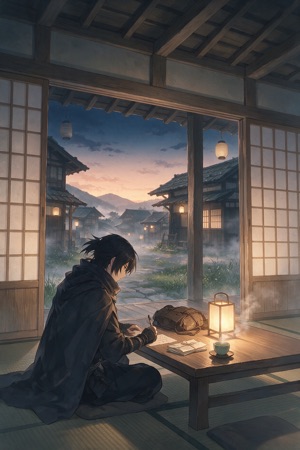
He rose before dawn, the sky still a bruise of indigo. The night guard had left his post, the shutters were still latched, and the lantern by the desk cast a tired amber glow. He slipped his boots on, the leather creaking like a sigh. The ledger from yesterday lay open, the ink still wet in the corners. He glanced at the appointments for the day, a thin strip of parchment pinned to the wall. Wednesday. Three names. Three lives intersecting with his schedule, three chances to feel the weight of the village settle on his shoulders.
The first name was written in a trembling hand: Yui Hayashi, widow of the fallen scout who had died in the battle of the river. He remembered the funeral—how the wind had carried the incense smoke over the battlefield, how the blood-stained earth still smelled of iron. He wondered if she would still be able to stand in his office, if the grief had already turned her limbs to stone.
He walked to the door, the wood protesting under his grip. The hallway was quiet, the only sounds the distant clatter of a broom sweeping the market square and the occasional rustle of paper from the clerk’s desk. He opened the door and found Yui already seated, her back straight, her hands folded on the table as if she were waiting for a summons. Her eyes were rimmed with dark circles, the kind that never fully fade.
“Good morning,” he said, his voice a practiced calm. “Please, have a seat.”
She lifted her gaze, and for a moment the room seemed to hold its breath. “Morning, Hokage-sensei,” she replied, her tone soft but edged with something like steel. “I… I need a permit for the new well.”
He nodded, already flipping to the appropriate form. “The well near the east ridge?”
She nodded, the motion small, like a leaf trembling in a wind she could not feel. “My husband always said the village needed fresh water. He… he never got to finish the plans.”
He wrote the name of the well, the coordinates, the required materials. He added a line for a special grant—extra stones for reinforcement, something the village council had set aside for families of the fallen. He could see the numbers in his mind, the ledger balancing, the budget stretching thin. He pushed the pen across the paper, each stroke a small act of defiance against the void that grief left behind.
“Will you be able to start soon?” he asked, watching the ink dry.
Yui’s eyes flickered to the window where the sunrise was beginning to bleed through the clouds. “I have a crew, but… we need the permit. And the council is… slow.”
He smiled, a thin line that did not reach his eyes. “I’ll see what I can do.”
She stood, bowed low, and left with the paper tucked under her arm. The door clicked shut behind her, and the silence returned, heavier now with the echo of a woman’s loss.
The second appointment was marked with a bright ink that reminded him of the shinobi’s headbands: Team 12. He had watched them train in the forest, the way their laughter bounced off the trees, the way the youngest, Haru, tried to copy his older brother’s jutsu but always misfired. They were eager, bright, a reminder that life could still sprout in the cracks of war.
When they entered, the trio was a swirl of nerves and excitement. The girl, Aiko, held a scroll so tightly her fingers turned white. The boy, Daichi, carried a bundle of scrolls and a bag of tools, his eyes darting between the door and the desk. The third, Haru, clutched a wooden kunai that looked more like a toy.
“Good morning, Hokage-sensei,” Aiko said, her voice a mixture of respect and curiosity. “We’re here about the training grounds.”
He gestured to the empty chairs. “Sit. Tell me what you need.”
Aiko spread the scroll on the table, the ink still fresh. “We want to request a new training field near the western forest. The current one is too close to the rebuilt houses. The kids keep tripping over the broken walls.”
Daichi added, “We also need new target dummies. The old ones were… well, they were used in the war. Some still have dents.”
Kakashi’s eyes softened for a fraction. He had seen the children’s faces, the way they tried to mimic the heroes they had heard about in stories, the way they tried to make something out of the ashes. He took the request, noted the dimensions, the materials—wood, bamboo, some steel for the frames. He knew the supply room was already low on timber, that the carpenters were overburdened with rebuilding houses.
He wrote, “Approve provisional training field. Allocate two sets of new dummies. Re-use surplus timber from the old barricades.” He signed, the seal of the Sixth Hokage pressing into the paper.
Aiko’s eyes brightened. “Thank you, sensei. This means a lot to the children.”
Daichi grinned. “We’ll make sure the new field is clean. No more war debris.”
Haru, who had been silent, finally spoke. “Will you come watch us train?”
Kakashi looked at him, at the hopeful innocence that seemed to glow like a lantern in a dark room. “If you don’t mind me being late, I will.”
The team left with a wave of relief, the sound of their footsteps echoing down the corridor. He watched them go, feeling a small, unexpected weight settle in his chest, like a stone that had slipped from a bag and rested against his ribcage.
The final appointment was the most formal. The name on the parchment was written in black ink, the official seal of the council stamped beside it. Councilman Ryo Nishimura. Ryo was a man of precise schedules, of long-drawn speeches, of arguments that could stretch from sunrise to sunset. He rarely visited the Hokage’s office unless something mattered.
When Ryo entered, his posture was immaculate, his coat immaculate, his eyes sharp as a hawk’s. He placed a stack of documents on the desk, the papers rustling like dry leaves.
“Good morning, Kakashi-san,” he said, his tone polite but edged with purpose. “We need to discuss the allocation of the reconstruction budget for the new market district.”
Kakashi nodded, pulling the ledger forward. “The market district is already slated for the next quarter. What changes are you proposing?”
Ryo lifted a sheet, his finger tracing a line. “There is a petition from several merchants to prioritize the eastern stalls. They argue that the western side is still too close to the old battlefields, that the wind carries dust and the smell of ash.”
Kakashi looked at the numbers, at the projected revenue, at the cost of moving the stalls. He could see the logistics—transporting goods, re-laying the foundations, the extra labor. He could see the faces of the merchants, their hope, their desperation to make a living after losing everything.
“Do you have the support of the council?” he asked.
Ryo’s eyes flickered to the window, where a breeze stirred the lantern light. “Only half. The others think we should focus on housing first. But the market brings tax revenue, which funds the housing.”
Kakashi thought of the ledger again, of the lines of red and black, of the way each entry represented a life. He could feel the pulse of the village under his fingertips, a rhythm that was both fragile and stubborn.
He tapped the paper lightly. “I will approve a pilot section—two stalls on the eastern side. If the merchants can show profit within a month, we expand. If not, we revert to the original plan.”
Ryo inclined his head, a small smile breaking the usual sternness. “A compromise. Thank you, Hokage-sensei. I will report this to the council.”
“Make sure the merchants understand the deadline,” Kakashi said. “We cannot afford endless delays.”
Ryo nodded, gathered the papers, and left with the same measured steps he had entered with. The door closed, and for a moment the hallway seemed to exhale.
Kakashi leaned back in his chair, feeling the ache in his lower back that had been growing over weeks of sitting on hard wood. He let out a breath that sounded like a whisper. He had handled the appointments without stumbling over the forms, without letting his mind drift into the abyss of loss that lingered behind every signature. Yet, as the day wore on, the cost became clearer.
When Yui returned later with the signed permit, she brought a small bundle of fresh carrots from her garden. She placed them on his desk, a quiet offering. “For the soup,” she said, her smile thin but genuine. “My husband liked carrots. He always said they made the broth richer.”
He took the carrots, feeling the weight of them in his hand, the firmness of the orange flesh, the memory of a man he never met but whose absence was a presence in every corner of the village. He thanked her, and she left, her steps lighter than before, though his heart felt a tug.
Later, the members of Team 12 returned, their faces flushed with the excitement of a new training ground. They presented a small wooden figurine they had carved—a tiny Hokage hat perched on a leaf. “For you,” Daichi said, his grin wide. “So you can remember us when you’re buried in paperwork.”
Kakashi laughed, a short sound that surprised even him. “I’ll keep it on my shelf.”
Aiko handed him a folded piece of paper. “A poem. My brother wrote it before the war. He said if we survive, we should read it aloud.”
He unfolded the paper, the ink smudged from age. The words were simple, about a river that kept flowing despite stones in its path. He read it aloud, his voice low, the syllables filling the small office. The poem seemed to stitch a thin thread through the room, binding the past and the present.
When the sun slipped lower, casting long shadows across the stone floor, Kakashi finally closed his ledger. He filed the documents, stacked the permits, placed the figurine on the top shelf, and tucked the poem into a drawer. He stared at the empty space where the day’s appointments had been, feeling the echo of each person’s need, each unspoken grief.
He walked to the balcony, the wind tugging at his cloak, the village lights beginning to twinkle like fireflies. The market district was a patch of darkness beyond the hill, the new well a faint glint in the east. He thought of the widow’s carrots, the children’s training ground, the merchants’ stalls. He thought of the weight of the ledger, the weight of the lives it represented.
He sighed, a sound that seemed to merge with the rustle of leaves. He was better at this than he had thought—at balancing the paper, at listening, at offering a carrot or a wooden hat. Yet each interaction left a mark, a small scar that grew deeper than any ink could show. The paperwork of the Sixth was a mask he wore, but the faces he met each day were the seams that kept it from tearing.
He turned back into the office, the lantern light flickering, the shadows dancing on the walls. He placed the carrots in a bowl, set the figurine beside his desk, and let the poem rest in the drawer. The day was over, but the ledger remained open, its pages waiting for tomorrow’s signatures. He closed his eyes for a moment, feeling the quiet grief settle like dust on his shoulders, and opened them again, ready for the next appointment.

The app remembers where you stopped, reads chapters aloud, and works offline. Writing lives there too.