Fluent
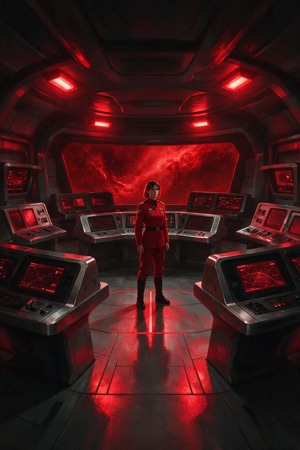
The Enterprise-D glided through the nebular fringe of the Betreka system with the quiet efficiency that had become routine on her fifth year of service. The warp core hummed at a steady 9.8, the deflector shield modulation pulsing in a low-frequency rhythm that kept the particulate veil from bruising the hull. At the forward sensor array, Lieutenant Commander Data adjusted the photonic filter to compensate for the high-energy emissions of the nearby star, while Lieutenant Worf monitored the shield harmonics for any unexpected resonances.
“Contact sensors are clean, sir,” Data reported, his voice as precise as the data stream he was parsing.
“Good,” Commander Riker replied, leaning against the bulkhead. “Keep an eye on the plasma dispersion. We don’t want a surprise flash fire when we break orbit.”
On the bridge, the Captain’s chair was empty; the commanding officer, Captain Jean-Luc Picard, was on the observation deck, reviewing the diplomatic brief. His presence was felt, though, in the measured cadence of the crew’s exchanges.
“Lieutenant Mbeki,” Riker called, turning his head toward the linguistics console where Adaeze Mbeki was already typing. The younger lieutenant’s dark hair was pulled back in a tight knot, a thin wire of a braid looping around her right ear. She had a reputation for making sense of the incomprehensible, a talent that had earned her the nickname “the code-breaker” among her peers. “We’ve got a response from the vessel.”
Adaeze glanced up, her amber eyes flicking over the console display. A series of glyphs cascaded across the screen, each one illuminated with a soft blue hue. The alien ship, a sleek, prismatic construct of unknown alloy, had opened a subspace channel and transmitted a greeting.
“Receiving,” she said, her fingers dancing over the keys. “Language is… astonishingly structured.”
Data inclined his head. “The transmission exhibits a syntax comparable to human language, but the lexicon does not align with known linguistic families.”
Adaeze tapped a command, and the translator’s algorithm began to parse the alien utterance. The ship’s universal translator, a marvel of quantum-entangled processing, rendered the message in flawless English.
“‘Welcome, travelers of the stars. We extend our collective peace to your presence.’”
She read the output aloud, the words flowing as naturally as if a native speaker had spoken them. “The translation is perfect, Commander. There are no errors in grammar, no missing particles. The meaning is… unambiguous.”
Riker smiled thinly. “Excellent. Let’s return the courtesy.”
Adaeze composed a response, her mind already considering the diplomatic weight of each clause. She knew the importance of mirroring the alien’s formality without overcommitting. The reply would be concise, respectful, and, most importantly, free of any implied individual agency that might be misread.
She typed:
“‘We thank you for your welcome. The Enterprise represents the United Federation of Planets. We seek to learn and to share.’”
A moment later, the translator confirmed the outgoing transmission, and the alien vessel’s lights flickered in a synchronized pattern. The bridge crew watched as the subspace window glowed, a thin ribbon of photons bridging the distance between the two ships.
The alien voice filled the bridge, its timbre resonant and oddly melodic, as if multiple vocal cords sang in unison. The universal translator rendered it verbatim.
“‘We have observed your vessel’s pattern of movement. Your approach aligns with the harmonic of our current state. We are prepared to exchange data.’”
Data’s ocular implants narrowed as he recorded the exchange. “They have initiated a data handshake. Their subspace burst aligns with a standard protocol for mutual information transfer.”
Riker glanced at the viewscreen. The alien ship’s exterior seemed to shift subtly, the prismatic surface refracting the nebular light into a kaleidoscope of colors. It was a beautiful sight, the kind of visual poetry that made even the most seasoned officer pause.
“Open a channel for visual communication,” Picard ordered from the observation deck, his voice calm, the edge of his command barely perceptible.
Adaeze engaged the holo-projector, and the alien vessel’s bridge materialized on the main screen. The beings that stepped forward were tall, slender, and covered in a smooth, silvery epidermis that seemed to pulse faintly with internal bioluminescence. Their faces were featureless save for a series of concentric ridges that radiated outward from a central point where a mouth might be.
One of them extended a limb toward the camera. The translator attempted to capture any vocalizations, but the sound was a low, harmonic hum that the universal translator rendered as a series of symbols, then into English.
“‘We are the Keltari,’ it said. ‘Our purpose is the continuation of the flow.’”
Adaeze’s eyebrows rose. “They don’t use pronouns. The sentence structure repeats the verb ‘continue’ in a loop, but there’s no subject.”
Data tilted his head. “Their language appears to lack a grammatical category for individual agency. All actions are expressed as extensions of the collective ‘flow.’”
Riker chuckled, a dry humor that rippled through the bridge. “So they’re saying ‘we’re happy to meet you’ without actually saying ‘we.’”
Picard’s eyes narrowed slightly, not in annoyance but in the focused curiosity of a diplomat. “We’ll respond in kind. Lieutenant, translate their greeting as accurately as possible, then formulate a reply that acknowledges their collective nature.”
Adaeze’s hands hovered over the console. She ran a subroutine that isolated the semantic core of the alien phrase. The algorithm highlighted the word for ‘flow,’ an abstract concept that in the Keltari lexicon represented change, movement, and purpose. There was no counterpart for ‘I’ or ‘me.’ The translation engine could render each glyph into English, but the underlying intent remained elusive.
She typed slowly, aware that each keystroke was a negotiation with an alien mind. “‘We welcome the flow of your presence. The Enterprise wishes to align its own flow with yours.’”
The translator flagged the phrase as a potential misinterpretation, suggesting that the word “align” carried an implication of choice that the Keltari might not comprehend. Adaeze suppressed the warning; she trusted the human instinct for diplomatic nuance over the sterile certainty of the algorithm.
The holo-projector shifted, and the Keltari responded with a synchronized ripple of their bioluminescent skin, a visual echo of their approval. Their voice, filtered through the translator, was a perfect echo of Adaeze’s words, each syllable landing with a clarity that left no room for doubt.
For a moment, the bridge seemed to exist in a perfect equilibrium—a human and an alien exchanging pleasantries through the most precise medium known to Starfleet. Data logged the exchange with his characteristic precision, noting the flawless syntactic match and the absence of any semantic discrepancy.
Then the subtle shift began.
The alien vessel’s hull emitted a low-frequency pulse that resonated with the Enterprise’s structural integrity sensors. The readout showed a minute fluctuation, a harmonic vibration that matched the Keltari’s description of “flow.” It was a physical echo of the linguistic exchange.
“Helm, adjust thrusters to compensate for harmonic resonance,” Riker ordered, his tone now edged with a hint of concern.
“Compensating,” the helmsman replied, his fingers flying over the control yoke. The Enterprise’s thrusters adjusted, their output modulating in micro-increments to counter the resonance.
Adaeze watched the displays, her mind racing. “They’re… translating our intent into a physical state. The ‘flow’ they speak of isn’t merely metaphorical.”
Data raised an eyebrow, his ocular implants flickering with data. “Their language appears to map semantic constructs directly onto quantum field variations. The phrase ‘align the flow’ may have triggered a corresponding field adjustment on their side.”
Riker turned to Picard, who had stepped onto the bridge, his expression unchanging. “Captain, are we dealing with a cultural miscommunication, or have we inadvertently synchronized our ship’s systems with theirs?”
Picard’s gaze lingered on the alien hull, the prismatic surface now rippling in tandem with the Enterprise’s thrusters. “Both, perhaps,” he said quietly. “We have spoken in their terms, but we have not understood the ramifications of those terms.”
Adaeze felt a prickle at the base of her neck, the same sensation she got when a calculation fell just beyond her reach. She accessed the translator’s back-end, pulling up the raw glyph stream. The Keltari’s language, she realized, operated on a dual channel: one linguistic, one energetic. Each glyph carried an encoded quantum state that, when spoken, altered the surrounding field.
She glanced at the clock on her console. Eleven days remained before the diplomatic window closed, a period set by the Federation Council to negotiate a trade agreement contingent on cultural exchange. The Keltari’s “window” was not a temporal one but a resonant one—a field alignment that could destabilize if left unchecked.
“Commander, we need to halt the exchange,” she said, her voice steady despite the sudden surge of adrenaline. “The synchronization is causing a feedback loop. If we continue, it could cascade into a systemic failure on both vessels.”
Riker’s eyes narrowed. “Can we reverse it?”
Adaeze typed a command into the translator, attempting to inject a null vector into the flow—an attempt to introduce a linguistic element that the Keltari could not map onto a quantum state. She chose a phrase that, in their language, would be semantically empty: a repetition of a verb without a subject, a linguistic construct that would translate as “continue continue” with no attached entity.
The translator rendered it as:
“‘Continue, continue.’”
She sent the message, watching the alien hull for any sign of response. For a heartbeat, the Keltari’s bioluminescence dimmed, then flared brighter, as if the phrase had been a jolt to their collective consciousness.
The alien voice returned, its tone now edged with an urgency that the translator struggled to capture. “‘The flow destabilizes. The continuation disrupts.’”
Data’s ocular implants emitted a soft click. “Their language cannot represent an individual’s intent to cease. The phrase ‘stop’ does not exist. They are expressing a systemic error without a concept of agency.”
Riker clenched his jaw. “So they can’t say ‘we stop,’ only ‘the flow stops.’”
Adaeze stared at the screen, the alien glyphs a tangled skein of light. “We have a problem,” she said, more to herself than to anyone else. “We spoke fluently, but we never understood that fluency here is a conduit for physical change.”
Picard stepped forward, his hand resting lightly on the console. “Lieutenant, what is your recommendation?”
Adaeze considered the options. She could attempt to sever the subspace link entirely, but that would likely be interpreted as a hostile act. She could try to modulate the translator to produce a phrase that would introduce a counter-field, a linguistic antidote to the resonant feedback.
She settled on the latter. “I’ll try a linguistic damping sequence. It will involve a phrase that, in their terms, represents a reversal of flow. The problem is we have no word for ‘reverse,’ only for ‘continue.’”
Data accessed the linguistic database, cross-referencing known alien languages for any concept that could be inverted. “There is a rare dialect of the Betreka natives that uses a term akin to ‘undo.’ It is a compound of the verb for ‘continue’ and a suffix indicating cessation.”
Adaeze nodded. “Combine it with a negation construct, even if it’s artificial. The translator will output something the Keltari can map onto a field reversal.”
She entered the command, constructing a phrase that, when parsed, would be a literal “not continue.” The universal translator strained under the weight of the artificial syntax, but the algorithm eventually produced a phonetic output that matched the alien vocal pattern.
The transmission sent out a low, harmonic tone, accompanied by a visual pulse on the holo-projector. The Keltari’s skin flared, then rippled in a wave that moved opposite the previous flow. The resonance on the Enterprise’s hull shifted, the harmonic tremor dampening into a gentle vibration.
“Field stabilization at 73 percent,” the engineering console reported.
Riker exhaled, a faint smile breaking through his disciplined demeanor. “Well done, Lieutenant. That was… elegant.”
Adaeze allowed herself a small smile. “Fluent, but not understood. We have to remember that language is more than words.”
Picard’s eyes softened. “In the end, we are still learning how to speak without breaking the table we sit at.”
The alien vessel’s hull settled into a steady glow, the bioluminescence now a calm, steady pulse. The Keltari extended their limb again, this time offering a visual pattern that resembled a star—perhaps a symbol of agreement.
Adaeze’s translator rendered it as: “We acknowledge the adjustment. The flow proceeds.”
She turned to the bridge, her voice low but confident. “They’re willing to continue. We have eleven days to figure out how to talk without moving the ship.”
Riker clapped a hand on her shoulder. “Good. Let’s make sure our next eleven days involve more listening and less moving.”
The bridge crew returned to their stations, the quiet hum of the warp core a reminder that the universe was vast, and the space between words could be as treacherous as any asteroid field. Adaeze stared at the alien glyphs one more time, the lines of light now a puzzle she was determined to solve before the window closed. The challenge was set, and the first contact—fluent yet fragile—had already taught her that true communication required more than a perfect translation; it demanded an understanding of the world that the words described.

The app remembers where you stopped, reads chapters aloud, and works offline. Writing lives there too.