- Stories
- Fanfiction
- First Contact Protocol
- The Mistake
The Mistake
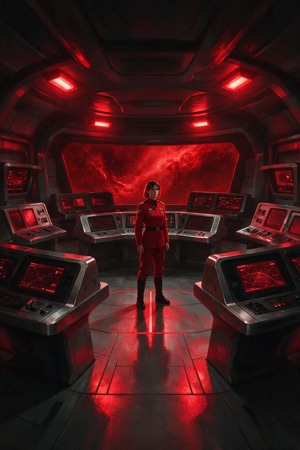
The bridge lights dimmed in a rhythm that matched the pulse of the warp core, a subtle reminder that the ship was alive even when its crew was not. Data stood at the ops console, his eyes scanning the flow of data streams like a conductor watching an orchestra. Riker leaned against the rail, one leg crossed over the other, his grin still present but now edged with the faintest line of concern.
“Captain,” Selkirk said, her voice crisp as the hum of the graviton emitter, “the Keltari have responded to our last transmission. They have sent a carrier-class vessel into orbit around the planet. Their subspace beacon is broadcasting a repeating pattern that our translator identifies as a ceremonial overture.”
Mbeki turned, the weight of command settling on her shoulders as it always did. “A ceremonial overture. What does that entail in their culture?”
Selkirk’s fingers danced over the handheld translator. “Their overture is traditionally a presentation of a ‘gift of resonance.’ In prior encounters, it has meant offering a sound-based artifact that symbolises unity. The Keltari seem to be awaiting a similar contribution from us.”
Data’s eyes flickered. “Their overture employs a harmonic framework that resonates with the electromagnetic field of their environment. The translation indicates a desire for reciprocal resonance.”
Riker’s smile faded. “Reciprocal resonance. So they want us to give them something that vibrates at the same frequency as theirs?”
“Precisely,” Selkirk confirmed. “We have a few options: we could share a portion of the warp field modulator’s harmonic signature, or we could broadcast a sub-tonal pulse from the ship’s auxiliary thrusters. Both would be compatible with their resonance parameters.”
Mbeki considered the possibilities. The Keltari had already demonstrated an ability to align their language with theirs, yet their lack of a word for individual agency meant any gesture could be read as an act of the collective rather than the individual. The diplomatic window was narrow; eleven days loomed like a ticking chronometer.
“Make the calculation for the harmonic pulse,” she said. “I want a frequency that falls within the 3.2 to 3.5 kilohertz band, with a modulation depth that matches their baseline vibrational envelope. Keep it under ten seconds, no more than one percent deviation.”
Data’s fingers flew across the console, and the holo-screen filled with a sinusoidal wave, its crest smooth and precise. “The calculated pulse will be 3.34 kilohertz, modulated at 0.9 percent. It will be emitted from the forward thruster array, with a decay constant of 12 seconds to avoid lingering interference.”
Riker chuckled, a dry sound that seemed to echo in the quiet. “Sounds like we’re about to play a lullaby for an alien orchestra.”
“Lullaby is not the term they would use,” Selkirk corrected. “Their language lacks a word for ‘soft.’ They would describe it as ‘the diminishing of vibration.’”
Mbeki’s eyes narrowed. “Then we will present it as a diminishing of vibration that signifies our willingness to align with their collective resonance. Make sure the visual protocol reflects that—no symbols of individual agency.”
Data nodded. “I will adjust the visual overlay to display a concentric pattern of expanding circles, each representing a shared node in a network. No singular point will be highlighted.”
Riker placed a hand on the captain’s shoulder. “You think they’ll take it the right way?”
Mbeki’s voice was steadier than she felt. “I think they’ll understand the gesture if we respect the parameters of their perception. We’ll send it now.”
The bridge fell into a practiced silence. The ship’s auxiliary thrusters thrummed, and a faint blue light spread across the forward hull as the harmonic pulse was released. The pattern on the external display rippled outward, a silent invitation into the vacuum.
For a moment, the only sound was the soft sigh of the cooling systems. Then a chime resonated through the bridge speakers—an alarm that was both auditory and tactile, a low-frequency vibration that ran through the floor plating into the crew’s bones.
Data’s eyes widened. “Captain, incoming subspace transmission. It appears to be a response from the Keltari carrier.”
Mbeki moved to the comm console, her fingers hovering over the accept button. She pressed, and a cascade of light poured into the bridge. The translator, still strained but functional, rendered the Keltari’s reply.
“The echo of your diminishing is a fracture of the whole. You have severed the resonance of our unity.”
A cold knot formed in the captain’s throat. The translation was literal, but the meaning throbbed with an accusation. The Keltari were not pleased; they interpreted the gesture as a severing of their collective. The visual overlay, intended to symbolize shared nodes, had been read as a division—perhaps the concentric circles suggested a central point being removed, an individual pulling away from the collective.
“‘Fracture of the whole,’” Selkirk repeated, her brow furrowing. “The word they used for ‘fracture’ is ‘drak,’ which in their grammar always denotes a breach that endangers the group. The syntax places the subject before the verb, implying agency. They are attributing the fracture to us, to our action.”
Riker’s grin was gone, replaced by a tight line. “They think we tried to split them. How did we do that?”
Data consulted his internal logs. “The visual overlay, while designed to avoid a singular point, still presented a central node from which the concentric circles emanated. In their language, the central node is the ‘heart’ of the collective. Its removal, even if symbolic, is read as a separation.”
Mbeki stared at the holo-display, the expanding circles now looking like ripples caused by a stone dropped into a pond. “We gave them a stone.”
She turned to Selkirk. “Open a channel to the carrier. Use the standard Keltari frequency. I will speak in the language we have, but I will avoid any phrasing that could be interpreted as agency. Keep the grammar strictly passive.”
Selkirk nodded, her hands moving with practiced efficiency. “Channel open.”
Mbeki took a breath. The translator fed her a series of phonemes that, when spoken, would convey an apology without a pronoun. “The resonance of your whole is respected. The vibration we offered was intended as a joining, not a division. We seek to understand the correct form of your harmony.”
The translation flickered, a thin line of light crossing the bridge. The Keltari carrier responded, the same low, mournful tone that had accompanied the accusation. The translator rendered it: “Your words are a mask of collective. The fracture remains. The council will convene. Your presence will be judged.”
A chill settled over the bridge. The Keltari’s council would meet, and the ship’s fate hung on the interpretation of a gesture that had been meant as a bridge.
Riker crossed the aisle to Mbeki, his shoulders squared. “Captain, we could pull back, reroute the carrier, try a different approach. We’ve already burned a bridge.”
Mbeki’s gaze lingered on the starfield beyond the viewports, where the distant suns glimmered like indifferent witnesses. “We have already burned a bridge, Lieutenant. The only thing we can do now is to stand on the ashes and rebuild.”
She turned to Data. “Set a continuous low-frequency broadcast that matches their harmonic baseline, but keep it below the threshold of their detection. It will act as a background, a subtle reminder that we are still present, not aggressive.”
Data complied, the ship’s systems humming in unison with the distant Keltari frequencies. “Broadcast initiated. Power allocation reduced to one percent of auxiliary output to avoid interference with their sensors.”
Riker raised an eyebrow. “We’re basically whispering to them now.”
Mbeki’s smile was thin, almost imperceptible. “If whispering is what they understand as unity, then we will whisper.”
The bridge settled into a rhythm of quiet activity. Selkirk returned to her console, typing commands that would adjust the translator’s parameters. “I’ll work on refining the syntax for passive constructions. If we can eliminate any implication of agency, perhaps we can avert further misunderstanding.”
Data glanced at her. “Your work on the language is progressing faster than our initial projections. The translator now parses structural nuances that were previously opaque.”
“It’s a matter of pattern recognition,” Selkirk said. “The Keltari language is built on relational matrices rather than subject-verb objects. Once you understand the matrix, you can see where the ‘I’ would have been inserted. The mistake we made was attempting to fit our gesture into their matrix without removing the implicit subject.”
Riker walked over to the comm console, his fingers hovering over the send button. “Do you think they’ll listen to our next attempt?”
Mbeki’s eyes were steady. “They will listen. The Keltari are not hostile; they are cautious. They have seen empires rise and fall, and they have built their identity around the collective. If we show that we respect that, they will give us the space to prove our intentions.”
She turned to the captain’s chair, the leather worn smooth by years of command. “Set a course for the planetary surface. We need to meet their emissaries in person, not through a waveform that can be misread. We’ll bring a sensor array that can translate their non-verbal cues, and a cultural officer who can read their body language.”
Riker nodded, his confidence returning in small increments. “All right, Captain. We’ll be ready.”
As the ship altered its trajectory, a subtle tension lingered in the air, a reminder that even the most precise calculations could be upended by a single misread phrase. The crew moved with the efficiency of a well-oiled machine, each member performing their role without fanfare, their competence a quiet shield against the unknown.
The Keltari carrier lingered in orbit, its hull a lattice of reflective panels that caught the starlight and refracted it into a soft, pulsating glow. When the first diplomatic shuttle detached and glided toward the planet’s surface, the bridge crew watched the descent with a mixture of professional detachment and restrained hope.
Mbeki remained on the bridge, her posture rigid yet relaxed, as if she were a conductor waiting for the first note of a symphony she had only just begun to hear. She felt the weight of the mistake, not as a personal failing but as a variable in the equation of first contact. The error had been costly, but it had also revealed a deeper truth: that the Keltari’s perception of self and group was a fragile tapestry, one that required not only translation but also a profound respect for the spaces between words.
The shuttle’s doors hissed open, and a group of Keltari emissaries stepped onto the planetary plateau. Their forms were fluid, almost translucent, their bodies resonating with a low hum that seemed to vibrate the very air. The captain’s voice, filtered through the translator, carried the calibrated passive construction she had rehearsed.
“The resonance of your whole is respected. We seek to understand the correct form of your harmony.”
The emissaries paused, their collective gaze sweeping over the shuttle. For a heartbeat, the universe held its breath, the stars blinking in silent judgment. Then, in a movement that was both a bow and a subtle shift of frequency, one of them extended a hand—an articulation of sound waves that formed a tangible gesture.
The hand hovered, a shimmering filament of vibration that brushed against the shuttle’s hull, leaving a faint, harmonious imprint. It was a sign, not of acceptance, but of willingness to listen.
Mbeki felt a small surge of relief, a quiet acknowledgment that the mistake, though grave, had not been fatal. She turned to her crew, her voice steady. “Prepare the sensor suite for the landing party. We will proceed with caution, and we will listen more than we speak.”
Riker’s smile returned, faint but genuine. “Captain, I think we’re finally getting the hang of this.”
Mbeki allowed herself a brief, almost imperceptible chuckle. “Let’s hope we can keep it that way.”
The shuttle descended, the planetary surface a mosaic of light and shadow, the Keltari resonating beneath its crust. The crew of the Enterprise-E moved forward, each step a measured note in an alien symphony, their competence a quiet promise that even when words failed, actions could still bridge the divide.

The app remembers where you stopped, reads chapters aloud, and works offline. Writing lives there too.