- Stories
- Fanfiction
- What the Borg Forgot
- The Record
The Record
The medbay lights were dimmed to a soft cerulean, the same hue the ship’s environmental regulators used for post-operative recovery. The air hummed with the faint vibration of the artificial gravity coils, a reminder that even in a place designed for stillness, the vessel’s systems never truly rested. Aran slipped his console into the docking port of the holo-table, his fingers moving with the practiced economy of a man who had spent more time calibrating immuno-filters than polishing his own reflection.
“Lira?” he asked, and the voice that answered was a thin, almost metallic whisper that rose from the half-transparent holosurface. “I’ve isolated the segment you asked for. It may take a few minutes to decrypt the sub-file layers.”
A faint sigh escaped the alien’s throat, a sound that, if it had been human, would have seemed like a draft through a cracked window. “Thank you, Commander.”
Yusuf, who had been adjusting a bio-scanner on the adjacent station, glanced up. “You know, I still can’t get over the fact that the Borg would have stored a child’s birthday card in a data matrix. Their idea of preservation is… peculiar.”
Aran allowed himself a small smile. “The Collective didn’t store anything that wasn’t deemed useful. That’s why we’re here.”
Yusuf’s eyes narrowed as he traced a line of code with his finger, the green light of the console flickering across his brow. “All right. I’ll run a cross-reference against the Assimilation Event Log. If we can pinpoint when the nanoprobes first made contact, we’ll know how much of her pre-assimilation timeline is missing.”
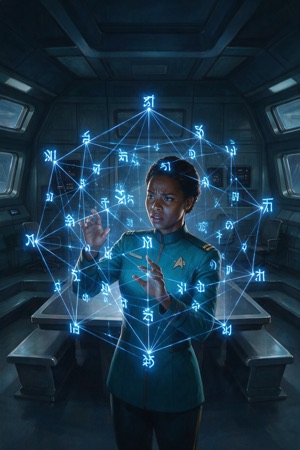
The holo-table blossomed into a three-dimensional lattice, each node pulsing with a faint amber glow. The visual was not merely decorative; it was an interactive map of the ship’s archived data streams, each strand representing a timeline of sensor logs, crew reports, and external observations. Aran’s hands hovered over the interface, and the lattice contracted, pulling the relevant threads into a tighter focus.
“Here,” Yusuf said, tapping a point on the lattice that corresponded to a date range three years prior. “We have an entry from a civilian transport vessel—Serran-II, class cargo—detected in the Alpha Quadrant, 2377. The transport was carrying a mixed cargo of agricultural goods and a small group of colonists from the Beta Colony system. The logs show a Borg cube intercepted them in the Gagarin Rift.”
Aran glanced at the timestamp. “That matches Lira’s last known coordinates before she was taken.”
“Exactly,” Yusuf continued. “The cube’s sensor sweep was incomplete; the data dump we received from the Borg during the cease-fire only captured the assimilated individuals, not the ancillary cargo. We have a partial telemetry feed, though. It includes a low-resolution holo-record of a family gathering. It’s… fragmented.”
Lira’s form shifted, the faint shimmer of her nanite-reinforced skin catching the light. “Do you think it could be… me?”
“The probability is low, but not zero,” Aran replied, his voice steady. “We’ll extract what we can. If there’s a personal recording, it might be stored in the ship’s auxiliary memory banks, a place the Collective would have skipped over because it wasn’t mission-critical.”
He initiated the extraction protocol, and the console emitted a soft chime as the ship’s mainframe allocated bandwidth. The holo-table flickered, the lattice expanding into a cascade of data points that settled into a compact buffer. A file name appeared: “LIRA_HOLO_LOG_001.”
“Looks like a personal log,” Yusuf observed, his tone dry as ever. “Probably a childhood diary, if the Borg didn’t wipe it clean.”
Aran lifted a gloved hand and brought the holo-projector into position. The image that blossomed before them was modest—a rectangular holo-frame set against a backdrop of a cramped living room. The walls were lined with hand-painted posters of starships, their sleek silhouettes rendered in bright, childlike colors. A small table held a tin of crayons, their caps scuffed from frequent use.
A young girl, perhaps eight or nine, sat cross-legged on the floor. Her hair was tied in twin pigtails, and she wore a simple jumpsuit that bore the insignia of the Beta Colony’s civilian service. She looked directly at the camera, her cheeks flushed with the excitement of a private moment. In her hands, she clutched a crumpled piece of paper.
“Hi,” she said, her voice pitched with the unsteady certainty of a child. “My name is Lira. This is my birthday. I’m turning nine today. My mom made a cake and we have balloons. I wish I could have a real starship for a birthday present. My dad says maybe one day we’ll get a visit from the Starfleet explorers, but for now we have a garden and a little pond. I hope my friends like the cake.”
The recording was grainy, the audio compressed into a narrow bandwidth, but the sentiment was unmistakable. A simple wish, untainted by the looming threat that would later engulf her world. The girl’s eyes sparkled as she lifted the paper, revealing a crude drawing—a starship rendered with a single line for the hull, two dots for windows, and a swirl for the warp core. Below it, in shaky script, she wrote: “Captain’s ship—fast. Bring us presents.”
The holo-record ended abruptly, the image dissolving into static as the recording cut off, perhaps due to a power surge or the sudden activation of Borg nanoprobes.
Silence settled over the medbay. The only sound was the faint whir of the holo-projector’s cooling fans. Lira stared at the fading light, her hands clasped tightly around the edge of the console. The lights caught the faint glint of the nanite mesh beneath her skin, an ever-present reminder of the assimilation that had overwritten so much of her.
“You didn’t… you didn’t have any… this?” Aran asked gently, his eyes never leaving her face. “Your family… your home?”
Lira’s shoulders rose in a shallow, almost involuntary breath. “I remember… a room that smelled of sap and metal. A voice that sang. A laugh that sounded like water over stones. But I also remember a darkness. The cold of the cube. The taste of metal in my mouth. It’s… fragmented.”
She turned her gaze toward the holo-table, where the child’s drawing still lingered in the residual after-image. “My mother’s voice… I think she sang lullabies. I used to hum them back, but I never learned the words.” Her tone was flat, as if cataloguing data rather than feeling it.
Yusuf set his scanner down, his hands clasped behind his back. “You know, most people would have broken down at this. Would have wanted to know everything, to fill the gaps. But you seem… content with the void.”
Lira’s eyes narrowed slightly, a motion that might have been curiosity or calculation. “Content?” she repeated, the word sounding alien in her own mouth. “I am… functional. The Collective gave me purpose. The crew gave me… another purpose. I do not know why I should cling to a memory that may be false.”
Aran’s mind raced. He had expected a surge of nostalgia, a longing to reclaim a lost past. Instead, the drone’s reaction was pragmatic, almost resigned. He felt a pang of something that resembled disappointment, but it was tempered by the professionalism that had guided him through countless crises.
“Lira,” he said slowly, “the purpose of this… exercise is not to force you into a past you might not recognize, but to give you the option to decide what you want to keep. If the memory is useful, you can integrate it. If it’s a burden, you can let it go. We’re offering you the data, not dictating its meaning.”
The drone’s gaze lingered on the child’s drawing, the simple swirl of a warp core. “If I keep it,” she said, “will it affect my performance? Will it interfere with the neural lattice?”
“Potentially,” Yusuf replied, his voice tinged with the dry humor that had become his hallmark. “It could introduce a recursive feedback loop in your pattern recognition matrices. But we can quarantine the memory segment, treat it like a sub-routine. You can enable or disable it at will.”
Lira tilted her head, the motion almost human. “A sub-routine I can turn off.” She smiled faintly, a fleeting curve that might have been more for Aran than for herself. “That is… efficient.”
The door to the medbay hissed open, admitting a senior medical officer, Dr. Selene Marquez, who stepped in with a tablet cradled in her hands. “Commander,” she said, nodding to Aran, “I’ve reviewed the neuro-profile. The drone’s synaptic response to external stimuli is within normal parameters for a liberated Borg. However, the introduction of pre-assimilation memories could trigger a cascade of adaptive reconsolidation. We’ll need to monitor the cortical activity closely.”
Aran glanced at Yusuf, then back at Lira. “We’ll set up a monitoring protocol. You’ll have a secure channel with us at all times. If anything feels… off, you let us know.”
Lira’s shoulders relaxed marginally. “Understood.”
The holo-projector dimmed, and the remnants of the child’s birthday faded into nothing. The empty space where the image had been felt like a void, but the room itself seemed less oppressive. The crew moved with practiced efficiency, calibrating the neuro-monitor, adjusting the holo-display settings, and logging the data into the ship’s central repository.
As the final diagnostic readouts streamed across the tablet, Aran allowed himself a moment to reflect. He had anticipated a revelation, a catharsis that would bind Lira to a past she had never known. Instead, he was presented with a measured, almost clinical acceptance. The drone’s experience of her own humanity—or what passed for it—was not a dramatic awakening but a quiet integration.
Yusuf broke the silence, his tone still laced with humor. “Well, at least we have a picture of a kid who wanted a starship for a birthday present. That’s a data point we can all relate to.”
Lira glanced at him, the faintest hint of amusement flickering in her eyes. “I would have liked a warp core cake. But I am… grateful for the gesture.”
Aran’s lips twitched. “We’ll see if we can synthesize something for your next birthday.”
She turned her attention back to the console, her fingers hovering over the icon that represented the extracted holo-log. “I will keep it,” she said, the words resonating with a quiet resolve. “For now, it will sit in the background, like a quiet song you hear on a long trek. If it becomes too loud, I will mute it.”
The comment hung in the air, an understated acknowledgement of the delicate balance between memory and present function. Aran nodded, feeling the familiar hum of the ship’s engines reverberate through the floor—an auditory reminder that they were all moving forward, regardless of the fragments they carried.
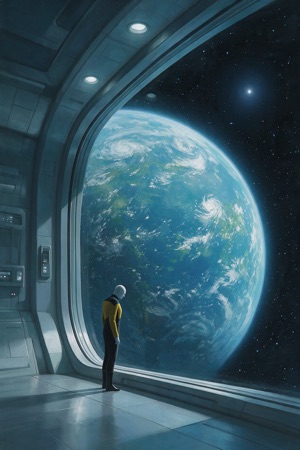
The medbay doors sealed with a soft hiss, and the crew returned to their stations. Outside the bay, the Aurora continued its silent glide through the void, its artificial gravity a constant, unassuming force. In the quiet of the observation lounge, the view screen displayed a swirl of stars, each one a point of light in the endless darkness.
Aran stood for a moment longer, watching the stars flicker. He thought of the child’s simple wish—a fast ship, a present, a cake shaped like a warp core. He wondered how many such wishes were whispered across the galaxy, never recorded, never remembered. In that thought, there was a hint of the same dry wit that had carried them through countless missions: the universe was vast, the data scarce, but the human (and now, partially Borg) desire for meaning was inexhaustible.
He turned, his steps measured, his mind already charting the next phase of the protocol. Lira would have a name, a record, a choice. The rest, as always, would be left to the quiet determination of those who tended the ship’s living systems, one patient at a time.

The app remembers where you stopped, reads chapters aloud, and works offline. Writing lives there too.