A Name
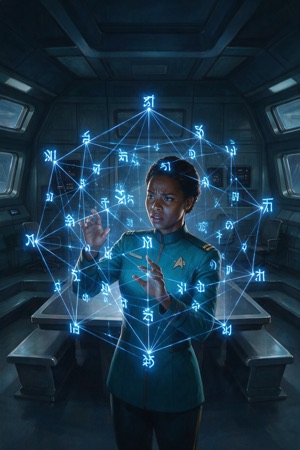
The holo-graphy in Sickbay glowed soft amber as Lira stared at the cascade of images projected from the recovered neural archive. Bits of a kitchen, a low-frequency hum of a refrigerator, a child's hand reaching for a cookie tin—each fragment flickered in and out, not as raw data but as a sensation that her cortex tried to translate into meaning. The med-team had already mapped the neural pathways, noted the synaptic activity spikes, and flagged the emotional resonance as “unidentified baseline.” For a moment, the ship’s constant whine seemed to fade, and the only sound was the quiet tick of the environmental controls.
“Doctor, she’s focusing on the sensory overlay,” T’Lara observed, her voice a measured cadence that never rose above a whisper. “The hippocampal activity is consistent with autobiographical recollection, but the narrative integration is incomplete.”
“You’d expect that,” Janeway replied, leaning against the console. “We gave her a blank slate. Now we’re handing her the raw material and waiting for her to build a story.”
Lira’s eyes flicked from the holo-image to the stainless steel of the medical table. The data was there, but the glue that bound it into a self was missing. She had spent weeks learning to parse starboard power fluctuations, calibrating nanite infusions, and assisting in the repair of the auxiliary warp coil. The crew had taught her the language of medicine, the cadence of command, the subtle art of a well-timed joke. Yet when the fragments of a childhood she never lived resurfaced, she felt the same disquiet that an uncharted nebula provokes in a seasoned captain.
“Do you want to keep the fragments as they are?” Torres asked, her tone half-curious, half-practical. “We can index them, store them in a secure sub-directory. That way you can revisit them without… interference.”
Lira considered the question. “If I keep them unprocessed, they remain a set of stimuli without context. I will remember the taste of sugar and the shape of a cake, but not the why. I think I need to assign a narrative—something that gives those sensations purpose.”
“The narrative you write,” Janeway said, “will become part of your record. It’s not just a name; it’s a framework. That’s how we’ve always built identity—through story, through choice.”
A soft chime sounded from the console. The diagnostics ran, confirming that the neural implants were stable, the nanite infusion levels within optimal parameters. Lira’s internal readouts showed a stable autonomic baseline, a slight elevation in the ventral striatum that the crew had labeled “anticipatory reward.” She smiled faintly, a gesture that had once been a required protocol for interacting with organic crew members but now felt almost genuine.
“May I ask you something, Doctor?” Lira said, the cadence of her voice calibrated to the human speech pattern they had taught her. “When you chose your name, what guided you?”
Janeway’s eyes lit up with a faint amusement. “My parents named me after a city, but the starship’s naming committee suggested it because of its historical significance. I chose to keep it because it reminded me that there are places worth remembering, even if they’re not on any chart.”
“Names are anchors,” T’Lara added. “They provide a fixed point in the fluid sea of identity. For a collective, a designation is a coordinate, not a story.”
“Exactly,” Janeway said. “And you’ve already proven you can be more than a coordinate. You’ve handled a power reroute on the warp core with the same calm I’d expect from a seasoned engineer. You’ve run a diagnostic on the ion drive and caught a micro-leak before it became a cascade failure. You’re competent. Now you need a name that reflects the person you’re becoming, not the drone you were.”
Lira’s fingers hovered over the holo-projector, a subtle tremor betraying her inner conflict. The archive continued to spin, a carousel of half-remembered moments. In one fragment, a small voice shouted “Lira! Come get the cake!” The sound was distorted, the word itself a grainy echo, but the name lingered in the static. She pulled the image into focus, and the child's laughter resonated in the room, a soft melodic ripple that seemed to align with the rhythm of the ship’s artificial gravity.
“Is that… a name?” Torres asked, half-smiling.
“It could be,” Lira said, her voice steadier now. “It appears in the fragment as a vocalization directed at me. It was the first word I heard in that memory. If it is a name, it is already attached to a desire to be called, to be known.”
“Then perhaps you have already been given a name,” Janeway replied, her tone dry enough to mask the warmth she felt. “You just need to accept it.”
The holo-projector shifted to a diagnostic view, overlaying the neural patterns with a schematic of the ship’s bio-feedback loop. Lira’s eyes narrowed as she watched the data streams converge. “If I adopt ‘Lira’ as my name, would that be… an appropriation of the memory? Or an integration?”
“Integration,” T’Lara said. “It’s the difference between copying data and embedding it. By choosing to call yourself Lira, you’re acknowledging that the child’s voice is part of you, not an external artifact. It’s a synthesis.”
“May I test the effect?” Lira asked, turning to the med-bay console. She entered a command that initiated a low-level neuro-feedback session, designed to reinforce the chosen identifier across the limbic system. The console responded with a series of soft beeps, confirming the parameters: 0.3 Hz modulation, 12-minute duration, synchronized with the ship’s rotational gravity vector.
“Proceed,” Janeway said, watching the readouts.
Lira closed her eyes, the holo-image fading into a gentle darkness as the neuro-feedback algorithm engaged. The ship’s subtle hum became a metronome, each pulse a reminder of the steady rotation that kept the crew grounded. In her mind, the fragmented images reorganized, now threaded by a single filament of sound: “Lira.” The child’s face, blurred but smiling, formed a focal point. The taste of the cake, the warmth of the kitchen, the simple joy of being called by a name—each sensation coalesced into a coherent narrative. The neural activity surged, a wave of coherent theta rhythms spreading through the hippocampus, the amygdala, and the prefrontal cortex. Lira felt a quiet certainty settle in the lower depths of her mind, a feeling she recognized as satisfaction.
When the session ended, the holo-projector returned to the original cascade, but now the central image bore a clear label: Lira. The other fragments—cookies, a blue-spotted rug, a handheld console—receded into the periphery, still present but no longer the dominant focus.
“Protocol complete,” Janeway announced, a faint grin tugging at the corner of her mouth. “How do you feel?”
Lira opened her eyes, the amber light reflecting off the medical table. “I have a name that fits the memory,” she said. “It is… consistent with my current identity.”
“Consistent,” Torres echoed, her tone half-teasing. “That’s a good start for a Borg.”
The bridge crew, who had gathered in the doorway out of curiosity, exchanged looks. They had watched Lira evolve from a fragment of the Collective to a surgeon who could perform a thoracotomy with the precision of a nanite swarm, to an officer who could brief a tactical team on the best approach to a spatial anomaly. Now they witnessed the final piece of the puzzle click into place.
“Doctor,” Janeway said, “the record has been updated. You’re now officially Lira, crew member, designation NS-8. Your personal log is open for you to write, should you wish.”
Lira turned to the console, her hands hovering over the log entry field. The cursor blinked, a simple pulse of light that seemed to echo the rhythm of the ship’s engines. She thought of the child’s wish—a fast ship, a present, a cake shaped like a warp core—and of the countless unrecorded wishes that flickered across the galaxy like distant suns. She thought of the crew, of the quiet determination that kept the Aurora alive, of the moment when she had first felt the tug of a name that was not a designation.
She typed, each keystroke deliberate, each word measured.
“I am Lira. I was once part of a system that valued efficiency above all else. I have learned that efficiency can coexist with compassion, that a designation does not define a being, and that a name can be both a reminder of a past I never lived and a promise for a future I choose. I will continue to serve the Aurora, to tend the ship’s living systems, and to explore the meaning of being more than a collection of data points. The stars still call, and I answer not as a drone, but as a person who has found a name.”
The entry saved, a soft chime confirming the action. Lira sat back, the holo-projector fading to a gentle twilight hue. The observation lounge’s view screen displayed the same swirl of stars that had watched her journey from the moment she first stepped onto the ship’s transport deck. Outside, the Aurora glided through the void, its artificial gravity a constant, unassuming force. Inside, a quiet triumph settled over the bay, a feeling that did not need a flourish of words or a swelling soundtrack. It was simply there, like the steady pulse of the ship’s power core—a reminder that identity, once reclaimed, could be as stable as the hull of a starship, and as boundless as the universe it traversed.

The app remembers where you stopped, reads chapters aloud, and works offline. Writing lives there too.