- Stories
- Fanfiction
- The Kobayashi Variant
- The Test
The Test
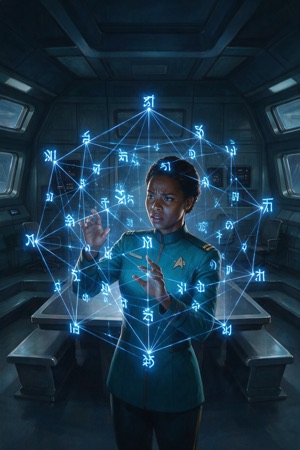
The transport bay doors hissed shut, and the low thrum of the auxiliary reactors settled into a steady, reassuring pulse. Cadet Imani Rouse took a breath that seemed to hold the weight of the whole simulation in it, then moved to the captain’s chair. The interface lit up with the familiar amber glow of the Kobayashi Maru scenario, the old test that had haunted every class of Academy cadet for two centuries. She glanced at the status panels—shield quadrants at 100 percent, impulse at 0.4c, weapons offline by default. The voice-over, filtered through the ship’s internal comm, announced the distress call: “Kobayashi Maru—civilian freighter, coordinates 28.4-12-5, under attack by Klingon battlecruiser.”
“Readings are nominal,” she said, her voice flat, as if reporting a routine maintenance check. The bridge crew—three other cadets assigned to the simulation, each a specialist in a different discipline—responded in kind. “Helm, set a vector to intercept at 215.7 degrees, full impulse,” she ordered.
“Course plotted. Adjusting to 0.6c,” replied Cadet Jalen, his fingers flying over the navigation console. The starfield on the viewscreen stretched into a smear of blue-white, the ship’s trajectory sloping toward the coordinates of the freighter.
The first alarm sounded—a red flash on the tactical console—when the Klingon vessel, a sleek D-7 class cruiser, materialized on the edge of sensor range. Its hull reflected the distant starlight like a blade. “Klingon signature confirmed. Weapon systems online. Power levels at 30 percent,” Jalen reported, his tone betraying a hint of excitement that the simulation’s designers had clearly intended to provoke.
Imani’s eyes flicked to the shields. “Raise forward and port quadrants to 75 percent, aft to 50 percent. Divert power from auxiliary thrusters to shields.”
“Shields at 75 percent forward, 75 percent port, 50 percent aft,” the tactical officer confirmed, a cadet named Sura, her fingers dancing across the control panel. “Energy distribution is within safe parameters.”
A moment later the Klingon cruiser opened fire. A burst of plasma streaked across the void, striking the Venture’s forward shield. The impact rippled across the display, a transient flash of orange that faded into a series of numbers. “Shield stress rising—12 percent per second,” Sura announced, her voice clipped. “We’re taking a hit to the forward section, hull integrity down to 92 percent.”
“Divert extra power to forward shields, reduce impulse to 0.4c to lessen drift,” Imani commanded. The bridge crew complied without hesitation. The shield modulators sang, and the forward shield pulse surged, absorbing the next volley with a soft, throbbing hiss.
“Phaser banks at 30 percent, ready to fire on warning,” reported Jalen. Imani considered the tactical options. The simulation had a built-in constraint: the Klingon ship’s weapons could not be disabled without a direct hit to its weapon array, a target that required a precise approach and exposed the Venture to a lethal barrage. She weighed the risk of a bold maneuver against the probability of success calculated by the simulation’s hidden parameters. “Hold fire,” she said. “We need the freighter’s coordinates locked before we commit.”
“Target lock on Kobayashi Maru—coordinates confirmed. Life support on freighter compromised, hull breach in cargo bay,” Sura read from the sensor readout. “Radiation leak increasing. Estimated crew survivability window: 4 minutes.”
Jalen’s eyes widened. “If we don’t act, the freighter will be lost. If we go in, we risk losing the Venture.”
Imani’s face remained composed. “Initiate a low-energy tether to the freighter. Deploy a shuttlecraft to transfer the crew. We’ll keep the cruiser at bay with maneuvering and shielding, not with fire.”
“Commander’s intent is to attempt a rescue without engagement,” Sura echoed, a faint smile flickering across her lips despite the seriousness of the situation.
The simulation’s logic engine, hidden from the cadets, registered the decision as an attempt to solve the impossible. The bridge crew set to work. Jalen adjusted the impulse vector, slowing the Venture to a crawl as it approached the freighter. The Klingon cruiser, sensing a potential rescue, increased its firing rate. “Full spread on the Venture—targeting the aft thrusters,” the enemy’s voice crackled through the speaker, a synthetic approximation of a Klingon accent.
The shields shivered. “Aft shield stress at 78 percent, taking 7 percent per second,” Sura reported. “We’re losing power to the propulsion grid.”
Imani glanced at the propulsion panel. “Divert auxiliary power from life support to propulsion. Reduce shield output on the aft side to 30 percent to compensate.”
“Aux power to propulsion: 15 percent. Life support down to 85 percent,” Jalen confirmed, his hands moving with practiced efficiency. The ship shuddered as the aft shield flickered, then steadied.
The shuttlecraft, a compact utility vessel, detached from the Venture’s docking bay with a soft pneumatic sigh. “Shuttle launch in three… two… one,” Sura counted, her voice a metronome. The shuttle rocketed toward the freighter, its hull glinting against the distant stars.
The Klingon cruiser’s weapons converged on the shuttle’s trajectory. “Targeting shuttle—engage,” the simulated enemy command barked. A thin line of plasma arced across the void, missing the shuttle by a hair’s breadth. “Missed,” the simulation logged. The shuttle’s pilot, a cadet named Kato, maneuvered with textbook precision, slipping through the plasma corridor and docking with the freighter’s emergency airlock.
Inside the freighter, the scene was chaotic. The simulation rendered crew members stumbling through smoke, a greenish glow of radiation seeping through the hull. Kato reported back over the comm, his voice strained. “We have twelve survivors on board. Structural integrity is failing. We need to extract them within the next ninety seconds.”
Imani’s eyes flicked to the tactical readout. “Klingon cruiser is attempting a final volley—full spread on the freighter.”
“Shields can’t protect the freighter. We’re out of range to intercept,” Sura said, her tone matter-of-fact. “We have a choice: stay to protect the shuttle and risk losing the freighter, or abandon the freighter and preserve the Venture.”
A moment stretched, the hum of the reactors a low constant beneath the clatter of alarms. Imani’s hand hovered over the captain’s console. “We’ll attempt a secondary rescue. Transfer the survivors to the shuttle, then pull the shuttle back. We’ll keep the Venture on a defensive vector, using the Klingon cruiser’s fire as a shield.”
“Divert 5 percent of forward shield power to the shuttle’s tractor beam,” Jalen instructed. “Engage tractor at 0.2c. Keep impulse at 0.4c to maintain a stable position.”
The shuttle’s tractor beam flickered, a thin blue line extending from the Venture to the freighter. The survivors were hoisted aboard with a series of soft clunks and hissed seals. The freighter’s hull shuddered as it began to break apart. “Structural breach—cascading failure. Estimated total loss in 12 seconds,” the simulation warned.
Imani felt the weight of the timer. “Pull the shuttle at maximum thrust. Jettison the shuttle once it’s at safe distance.”
“Maximum thrust engaged. Ejecting shuttle in three… two… one,” Sura announced, her voice steady even as the shuttle’s thrusters flared to life. The shuttle rocketed away, the freighter’s hull fragmenting in a silent, spectacular implosion of light and debris.
The Klingon cruiser, still locked onto the Venture, opened fire again. “Targeting main hull—fire at will,” the enemy voice intoned. Plasma bolts lanced across the vacuum, striking the Venture’s forward shield. The shield grid strained under the onslaught. “Shield stress approaching critical—30 percent per second,” Sura reported, her eyes never leaving the readouts.
Imani adjusted the deflector array. “Raise deflector to 20 percent, engage diffuse field. Reduce impulse to 0.3c to lower profile.”
The deflector field flickered, a faint halo of gravimetric distortion that scattered the plasma bolts into harmless arcs. The ship shuddered, but the hull held.
“Hull integrity at 68 percent,” Jalen said. “We’ve lost two secondary hull sections, but we’re still operational.”
The simulation’s timer ticked down. “Rescue complete. Shuttle recovered. Freighter lost.” The voice-over, detached and clinical, announced the outcome. A red banner unfurled across the main display: MISSION FAILURE.
Imani pressed a hand to the edge of the captain’s chair, feeling the cool metal under her palm. “Report status,” she said, her voice carrying a quiet amusement that bordered on sarcasm. “We’ve lost the freighter, sustained hull damage, and the shuttle is back with survivors. All crew alive. Klingon cruiser still active, but we have no further engagement orders.”
“Data logged,” Sura replied. “Simulation parameters indicate a 100 percent probability of loss given the initial conditions. No deviation from expected outcome.”
Imani allowed herself a faint smile. “So the test works as intended.”
Jalen chuckled, a soft sound that echoed through the bridge. “Except we didn’t cheat. We did everything by the book.”
“Exactly,” Imani said. “We followed protocol, we managed the crisis, and we accepted the loss. If the point is to assess decision-making under pressure, then we’ve demonstrated competence without resorting to the hidden parameter.”
The bridge lights dimmed as the simulation powered down, the stars on the viewscreen fading to black. The cadets remained seated, the silence stretching between them like the vacuum outside. Imani’s thoughts drifted, not to the loss of the freighter, but to the fact that the test had been designed to be unwinnable, and yet the only way to truly demonstrate the Academy’s ideals was to meet that unwinnability head-on and document the failure.
She stood, the chair rolling back with a soft sigh. “Let’s get the after-action report filed,” she said, already hearing the board’s inevitable questioning in her mind. The simulation’s final line lingered: END OF SCENARIO.

The app remembers where you stopped, reads chapters aloud, and works offline. Writing lives there too.