- Stories
- Fanfiction
- The Kobayashi Variant
- Finding
Finding
The morning light fell through the high-gain windows of the Academy’s central atrium, a thin band of solar illumination that painted the marble floor in a soft amber. Imani moved with the practiced confidence of someone who had already rehearsed the day’s script in her mind. The board’s decision had arrived in a sealed packet the night before, slipped into the console’s intake slot by an officer who had been told not to linger after the last report was filed. She had opened it in the privacy of her quarters, the crisp paper crackling as she turned the pages, and had read the verdict twice before she let the words settle.
The ruling was simple, almost elegant in its bureaucracy. The Board of Examination affirmed that the Kobayashi Variant simulation, as designed, still measured the qualities it intended to test—adaptability, command presence, and the capacity to make hard choices under fire. However, the Board also concluded that any deliberate “loss” strategy, even when articulated with flawless logic, undermined the core purpose of the scenario: to expose cadets to the limits of their authority and to force them to confront the inevitability of failure. Accordingly, they granted her report a “recommendation for revision” status, but imposed two conditions: she would be barred from the command track for the remainder of her academic year, and she would serve as the simulation’s instructional officer for the next intake, responsible for briefing the new cadets on the parameters and the philosophical underpinnings of the test.
Imani read the words again, the ink slightly smudged where her thumb had lingered. The cost was not a demotion, not a discharge, not a stain on her record. It was a redirection of her trajectory—a postponement of the path she had charted for herself, a temporary diversion into the role of teacher rather than commander. She set the packet down, folded it neatly, and slipped it back into the console’s slot. The hiss of the door was the same soft sound that had accompanied her earlier departure; now it marked an arrival.
She walked the short distance to the Simulation Deck, the hallway’s ambient temperature set to a comfortable 21 °C, the air filtration system humming at a steady 1.2 kW. The deck itself was a cavernous space of modular panels, each one a wall of fused quartz and titanium, housing an array of holo-emitters, gravitic projectors, and sensor suites. The Kobayashi Variant simulation ran on a cluster of quantum processors, its subroutines constantly adjusting to the cadet’s inputs, the starfield outside the viewport flickering as the virtual starship drifted toward a binary pulsar.
The senior instructor, Lt. Cmdr. Reyes, greeted her at the entrance. “Cadet Rouse, the board’s decision is in,” he said, his tone neutral, his eyes flicking to the console panel where the decision had been logged. “You’ll be taking over the briefing schedule starting at 0900 tomorrow. The new intake is on deck three.”
Imani nodded. “Understood. I’ll run the pre-simulation checklist and make sure the parameters are locked in as per the revised protocol.”
Reyes raised an eyebrow. “Revised protocol?”
“Board recommendation,” Imani replied. “They want us to emphasize the inevitability of loss, not the possibility of a perfect evasion.”
He chuckled, a low, dry sound. “The Board’s idea of inevitability is that the simulation will still let you cheat the system if you’re clever enough. Let’s see if the new cadets are as clever as you were.”
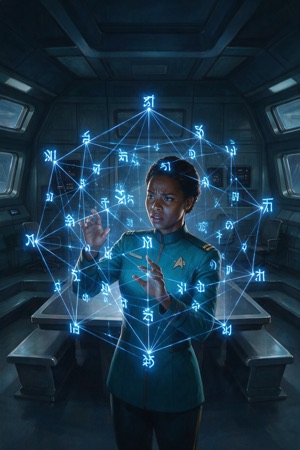
She entered the control room, the glow of holographic displays bathing the walls in a pale teal. The main console showed a schematic of the Kobayashi Maru—a dilapidated civilian freighter stranded in a sub-space anomaly, its power grid at 0.43 of nominal, its hull integrity compromised by micro-meteoroid damage. The scenario parameters were already set: a Romulan warbird on an intercept course, a starbase at the edge of the nebula, limited warp core reserves. The crew’s tactical console displayed a radial map of the surrounding space, the Romulan warbird’s vector plotted in a thin orange line, the warp core output limit marked in red.
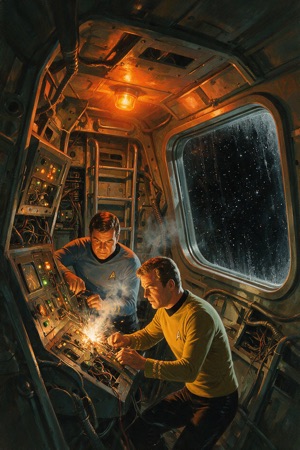
She began the standard pre-simulation routine, her fingers moving over the touch-sensitive panels with the ease of a pianist. “Power distribution to the forward warp coils at 78 %,” she said, speaking into the intercom. “Shield modulation set to 0.63 to compensate for hull breach. Auxiliary plasma injectors calibrated to 0.92 of nominal output to maintain a stable plasma flow under the stress of sub-space distortion.”
A voice crackled from the adjacent console. “Cadet, diagnostics report a fluctuation in the quantum entanglement field of the holo-emitters. Reading at 0.04 Hz off the expected baseline.”
Imani glanced at the readout. “That’s within tolerances. Compensate with a 1.2 % increase in emitter gain. It’ll keep the visual fidelity consistent for the crew’s situational awareness.”
She noted the minor adjustments, the way the system responded to each input, the balance of power, the interplay of shields and propulsion. The simulation was a symphony of interlocking subsystems, each one requiring a precise hand to keep the whole from descending into chaos.
When the doors to the briefing room opened, a group of fresh-faced cadets filed in, their uniforms crisp, their ranks still blank. The senior cadet, a lanky officer-candidate named Soren, took the lead. “We’ve heard about the Kobayashi Maru,” he said, his voice tinged with the confidence of someone who had only read the textbook version. “We know it’s a test we can’t win.”
Imani smiled, a thin line that didn’t reach her eyes. “It’s also a test we can’t lose—if you understand the parameters.” She gestured to the holo-display behind her, where the image of the battered freighter hovered, its hull scarred, its lights flickering. “The variant you’ll be running today has been modified to reflect a more realistic set of constraints. The Romulan warbird will have a compromised sensor array, limiting its targeting accuracy to 73 %. Your power core is at 58 % efficiency. And the starbase you can call for rescue is on a low-priority communications schedule, meaning a delay of at least 3.7 minutes before they can respond to a distress call.”
A cadet in the front row, her name badge reading “T’Lara”, raised a hand. “If the simulation is designed to be unwinnable, why would the Board want us to study it?”
Imani tilted her head. “Because understanding loss is the only way to make a decision that preserves what matters. The simulation isn’t a puzzle to be solved; it’s a scenario to be lived through. Your ship’s captain must weigh the lives of the crew against the lives of the civilians on the freighter, and against the strategic implications of engaging a Romulan vessel. The answer isn’t in the data sheet; it’s in the judgment you make when the data collapses under the weight of reality.”
She heard a faint chuckle from the back. A senior instructor, Cmdr. Hsu, who had been observing from the doorway. “You’re giving them a philosophy lecture, Rouse. That’s not in the syllabus.”
Imani turned, meeting his gaze. “It’s in the syllabus, Commander. It’s in the sub-text of every command decision. The Board’s compromise is that we’ll teach them the cost of a perfect loss. Not to glorify failure, but to give them a framework for handling it.”
Hsu raised an eyebrow, then nodded. “Fine. Let’s see if they can handle it without you having to file another report.”
The briefing concluded with a brief walk-through of the simulation’s controls. Imani demonstrated how to allocate power, how to adjust shield harmonics, how to engage the auxiliary plasma injectors for a burst of thrust. She pointed out the diagnostic readouts, explaining that a 0.04 Hz deviation in the holo-emitter field could cause a visual lag, but that it was not a critical systems failure.
When the cadets took their seats at the simulation consoles, the holo-deck lit up, the stars beyond the viewport shifting as the virtual Kobayashi Maru drifted toward the Romulan warbird. Imani watched the readouts flicker, the cadets’ hands moving with tentative precision. She could see the tension in their postures, the way their eyes darted between the tactical display and the engineering console.
The first cadet, Soren, engaged the warp coils at 71 % and raised the shield modulation to 0.68. The Romulan warbird locked on, its phaser arrays charging. “Diverting power to forward shields,” Soren announced, his voice steady. “Compensating for hull breach with auxiliary plasma injectors.”
A warning chime sounded. “Hull integrity at 23 %,” the console reported. “Warp core output at 55 %.”
Soren hesitated. “We can’t sustain full warp, but we can try a 0.4G jump to evade.”
Imani observed the calculation, the small delays as the system rebalanced the power grid. The Romulan warbird fired a salvo. The phasers struck the freighter’s hull, a spray of orange light against the dark of space. The simulation’s damage model showed a breach expanding along the starboard bulkhead, a cascade of coolant loss.
“Redirecting all available power to forward thrust,” Soren said. “Initiating emergency warp.”
The virtual starship surged forward, the warp field stabilizing at a slight wobble. The Romulan warbird attempted to track, its compromised sensors giving it a jittered vector. It missed, its phasers passing harmlessly through the vacuum.
“Routed distress signal to Starbase 12,” Soren added. “Awaiting response.”
The seconds ticked by in the simulation. The starbase’s reply came after 4.2 minutes, a delay consistent with the low-priority communications schedule. The starbase offered a rescue vector, but it required the Kobayashi Maru to hold position long enough for a shuttle to dock, a maneuver that would consume the remaining power reserves.
Imani watched as Soren made the call. “We’ll hold position for the shuttle,” he said. “Diverting all remaining power to life support and shield reinforcement. We’re not going to survive a full engagement, but we can keep the freighter intact for the rescue.”
The simulation’s metrics showed the ship’s power core collapsing, the warp field collapsing, the freighter’s hull holding just enough to prevent total loss. The Romulan warbird, seeing the maneuver, disengaged and slipped away into the nebula.
The debrief was swift. Imani asked the cadets what they had learned. “That sometimes you have to choose the lesser of two evils,” Soren answered. “You can’t always win, but you can still act responsibly.”
She noted the cadet’s response, the subtle shift in their comprehension. The lesson had landed, not as a triumphant declaration, but as a measured understanding of constraint.
When the simulation ended, the deck lights dimmed, the holo-emitters powering down. Imani turned to the cadets. “You did not save the ship,” she said, “but you saved the lives you could. That is the essence of command. The Board’s compromise has given us a chance to teach that reality, even if it costs me the command track for a year. I will be here, guiding you through the loss, because I believe that understanding how to lose is as vital as knowing how to win.”
She felt the weight of the decision settle in her chest, a quiet pressure that matched the hum of the station’s core. It was not the accolade she had imagined when she first entered the academy, but it was a responsibility she could accept. The Board had taken from her a shortcut, a fast-track promotion, but in exchange it had offered her a role that aligned with the very principle she had championed: competence under pressure, no matter the outcome.
The next morning, the intake of new cadets assembled in the briefing room, their faces a mix of anticipation and the nervous energy that accompanied any first test. Imani stood at the front, the same console panel humming softly behind her. She glanced at the fresh faces, then at the holo-projector that would soon display the familiar silhouette of the Kobayashi Maru, battered and drifting in the void.
“Good morning,” she began, her voice steady. “Welcome to the Kobayashi Variant. This simulation has a reputation for being unwinnable, but it is also a tool. A tool that forces you to confront the limits of your authority, the constraints of your ship, and the weight of your decisions.”
She tapped a command on the console. The holo-deck lit up, the starfield beyond the viewport shimmering. The freighter appeared, its hull scarred, its power grid flashing at 0.42 of nominal.
“This version,” she continued, “has a Romulan warbird on intercept, a starbase on a delayed communications schedule, and a power core that will not sustain full warp for more than three minutes. Your objective is to make the best possible decision with the resources you have. There is no ‘right’ answer. There is only the answer you choose, and the consequences that follow.”
A cadet in the back, his name tag reading “Parker”, raised a hand. “So we’re supposed to lose?”
Imani smiled, a thin line that hinted at the dry wit she kept in reserve. “No, Parker. We’re supposed to understand what loss looks like, and why you might accept it. You may still save lives, you may still preserve the ship, you may still find a way to mitigate the damage. The point is to make a decision that you can stand behind when the after-action report is filed.”
She watched the cadets absorb the information, the way their eyes flicked to the tactical display, the engineering console, the haptic feedback panel on their seats. The simulation would soon begin, the Romulan warbird’s sensor array beginning to lock onto their position, the starbase’s delayed reply ticking down. Imani knew the cadence of the upcoming engagement; she had run the scenario countless times, had adjusted the plasma injectors, re-calibrated the holo-emitters, and had taught it to herself in the quiet hours after the Board’s ruling.
When the Romulan warbird appeared on the tactical screen, its phaser banks glowing a muted violet, the cadets’ fingers hovered over the controls. Imani stepped back, her posture relaxed, her mind already cataloguing the outcomes, the decisions, the moments when competence would be measured not by victory but by execution.
She felt a faint pulse in the station’s core, a low hum that resonated through the deck, a reminder that even in the vastness of space, progress was a series of measured steps. The Board’s compromise had redirected her path, but it had not derailed it. Instead, it had placed her at the nexus where theory met practice, where the next generation would learn that sometimes the most skilled action is to acknowledge the parameters you cannot change, to adapt within them, and to carry the weight of that adaptation with dignity.
The holo-deck flickered as the simulation engaged, the stars outside the viewport shifting into a slow, deliberate rhythm. Imani watched the cadets begin to allocate power, to adjust shield harmonics, to decide whether to divert power to the forward thrust or to the auxiliary plasma injectors. The Romulan warbird fired, the phaser bolts arcing across the vacuum, the freighter’s hull shuddering under the impact.
In that moment, Imani felt the quiet satisfaction of a measured solution taking shape. The board’s decision had cost her a promotion, but it had given her a seat at the table where the future of Starfleet’s leadership was being forged. She had lost the test, deliberately, and now she was winning the larger game—ensuring that the lesson she had learned would be the one the next intake would carry forward.
The simulation’s outcome would be recorded, the after-action report filed, the cadets debriefed. But for Imani, the real finding lay not in the data points, but in the steady hum of the station’s core, the slow pulse of the stars beyond the hull, and the quiet, competent resolve of a cadet who had chosen to lose, not for defeat, but for the sake of a better test.

The app remembers where you stopped, reads chapters aloud, and works offline. Writing lives there too.