- Stories
- Fanfiction
- The Kobayashi Variant
- The Board
The Board
The hearing room smelled faintly of recycled air and the metallic tang of an old starship’s coolant. The translucent wall panels gave a view of the academy’s orbital garden, where saplings swayed in a simulated breeze, their leaves catching the soft amber of the artificial sun. At the long, low table sat three senior officers, each a pillar of the institution, and across from them, cadet Imani Rouse, still in her uniform but with the rank insignia of a cadet set back at her shoulders. She took her seat, placed her report in the central console, and waited for the first voice to break the silence.
Commodore Elise Larkin adjusted the lapel of her dress uniform, the polished gold braids catching a glint of the overhead lighting. “Cadet Rouse,” she began, her tone precise, “you are aware that the Kobayashi Maru has been a litmus test for leadership under impossible conditions for over a century. Your report suggests that the test’s parameters are fundamentally flawed. Explain, in your own words, why you believe a deliberate loss constitutes a valid result.”
Imani opened the report, her eyes scanning the lines she had written weeks earlier. “Commodore, the simulation is designed to evaluate a commander’s capacity to make decisions when no solution exists. My approach was to acknowledge that premise, to accept the loss, and to focus on the quality of the decision-making process leading to that loss. I argued that a commander who can maintain ethical standards, crew safety, and mission integrity while conceding defeat demonstrates the same—if not greater—competence than one who seeks a contrived win.”
The commodore’s eyes narrowed, not in anger but in calculation. “You are arguing that the test measures the willingness to surrender rather than the willingness to try. That is a significant shift. How do you justify this to a fleet that must sometimes act decisively in the face of overwhelming odds?”
Imani’s voice was steady. “Because decisive action without a realistic appraisal of risk can be catastrophic. The original scenario forces a commander to choose between a no-win and a reckless win. In either case, the crew’s welfare is compromised. By accepting the loss, the commander can allocate resources to minimize casualties, preserve the ship, and learn from the failure. The test should reward that sort of professionalism.”
A soft chuckle slipped from the back of the room. Captain T’Vara, a Vulcan-born commander with a reputation for unorthodox tactics, leaned forward. “Cadet, you are asking us to rewrite a tradition that has, for a reason, endured through wars, genocides, and the most harrowing of crises. The Kobayashi Maru is not merely a test of engineering or tactics; it is a test of resolve. When I took the simulation on the USS *Dauntless* during a field exercise three years ago, I chose the impossible. I tried to rescue the vessel, I pushed the warp core beyond its rated capacity, and I engaged the enemy in a desperate maneuver. We lost the ship, but the crew survived. The lesson was that sometimes you must gamble everything to protect your people.”
Imani’s brow lifted. “You are saying that a successful rescue, even at the cost of the ship, validates the test’s premise?”
Captain T’Vara’s eyes, a deep amber, reflected a calm that belied the memory of that day. “The *Dauntless* was a test ship, stripped of non-essential systems to simulate a real-world scenario. The warp drive was operating at 8.2, just shy of the safety limit. I ordered a warp field expansion to breach the enemy’s sensor grid. The field destabilized, the core spiked to 9.1, and we suffered a cascade failure. The bridge crew ejected, the ship’s emergency containment held, and the Kobayashi Maru—an unmanned freighter—remained unrescued. The loss was total, but we learned how to mitigate core breach protocols under duress. That was the point: the simulation forced us to confront the limits of our engineering and our ethics.”
Imani nodded, noting the precise figures. “You are emphasizing the technical learning that emerged from a controlled loss.”
“Exactly,” T’Vara replied, his tone dry as the vacuum outside. “If a commander can orchestrate a graceful failure, that is a skill worth measuring. The test’s value lies not in the outcome but in the process.”
The third officer, Lieutenant Commander Maya Saeed, the chief designer of the simulation, cleared her throat. Her uniform bore the insignia of the Academy’s Research and Development division, and a thin scar traced the left side of her jaw—a reminder of a past accident. “Commodore, if I may,” she said, “the simulation’s code was written to force a binary decision: either commit to the rescue and die, or abandon and survive. We built the scenario to expose the commander’s capacity to balance risk versus reward. Cadet Rouse’s argument suggests we replace the binary with a spectrum of outcomes, but that would require a fundamental rewrite of the decision-tree logic.”
Larkin tapped a fingertip against the console. “Lieutenant Commander Saeed, are you prepared to redesign the simulation to include a ‘deliberate loss’ pathway? That would entail adding new parameters: crew morale decay, resource allocation during failure, and post-event analysis. It’s a substantial undertaking.”
Saeed’s eyes flicked to Imani. “Your report proposes exactly that, but you also claim the test’s premise is outdated. Do you intend to keep the rescue objective, or are you suggesting we abandon it entirely?”
Imani took a breath, feeling the weight of the room. “I propose we keep the rescue objective but add a structured failure mode. The commander would be evaluated on how they manage the inevitable loss: minimizing casualties, preserving data, ensuring a clean ejection of the crew, and initiating post-event debriefs. The simulation would then generate a metric for ‘controlled failure efficiency,’ comparable to the current ‘rescue success index.’”
T’Vara interjected, his voice carrying that dry Vulcan humor that always seemed to surface at the most opportune moments. “So you are asking us to reward the commander who can lose a starship with the same dignity as one who can win it. That is… an interesting proposition. It would make the academy the first institution to officially commend competent surrender.”
A faint smile crept across Saeed’s lips. “If we quantify the variables correctly, the system can calculate a loss-efficiency coefficient, LEC, defined as (crew survived ÷ total crew) × (critical data retained ÷ total critical data) × (energy expended ÷ maximum allowable energy). A higher LEC would indicate a better controlled loss. The current simulation lacks this metric entirely.”
Larkin raised an eyebrow. “And you think this will produce better officers?”
Imani answered without hesitation. “The fleet needs officers who can assess when a mission is untenable and still protect their people and the larger strategic picture. By measuring how well they manage a loss, we teach them that surrender is not a sign of weakness but a calculated decision.”
The commodore stared at the report for a moment, then at the three officers. “We have three positions here: one who values tradition and the moral high ground, one who has lived the test’s consequences, and one who builds the simulation itself. Each has a legitimate perspective. The question is whether we can reconcile them into a coherent policy.”
T’Vara folded his hands, the faint scar on his knuckles catching the light. “Cadet, you must understand that the Federation’s Command Codes—especially Article VII, Section 3—require a commander to preserve the ship and crew whenever possible. The Kobayashi Maru was designed to test that very principle under impossible conditions. If we change the test to reward failure, we risk encouraging a culture where loss is acceptable, even when a win is possible.”
Imani’s voice softened, not out of defeat but out of respect. “I am not advocating for a culture of defeat. I am advocating for a culture of realistic assessment. In the *Dauntless* exercise, we were forced to accept loss because the physics of the warp field collapse left us no alternative. The crew’s survival rate was 92 percent, and we recovered the ship’s logs, which later informed a redesign of the warp core safety valves. That was a win, albeit a different kind of win.”
Saeed leaned forward, her hands resting on the console’s edge. “From a design standpoint, we can implement a dual-track evaluation. Track A would be the traditional rescue success; Track B would be controlled loss. We would then assign a composite score, weighted perhaps 60 percent rescue success, 40 percent loss efficiency. That would preserve the test’s original intent while acknowledging the practical realities you both have experienced.”
Larkin exhaled slowly. “The Board must decide whether to adopt this dual-track model. We need to consider the impact on curriculum, on future training cycles, and on the message we send to cadets. If we tell them that losing can be a path to commendation, will they still strive for victory?”
T’Vara’s tone held that familiar Vulcan mix of logic and wryness. “Cadets will always strive for victory if they understand the stakes. The problem arises when they cannot see the stakes. A controlled loss provides a clear, quantifiable outcome that reinforces the importance of mission parameters. It also teaches that a commander must be honest with his superiors about what is achievable. In the *Dauntless* case, I reported the loss immediately, and the fleet command adjusted its deployment strategy. The loss was not a failure; it was an information point.”
Imani reflected on that. “In my report, I argued that the test’s current binary outcome forces cadets to improvise a win, sometimes at the expense of safety protocols. By adding a measured loss pathway, we give them a framework to evaluate risk analytically, not intuitively. It aligns with the Federation’s emphasis on data-driven decision-making.”
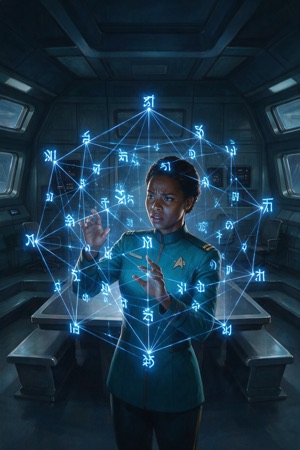
Saeed tapped a few commands into the console, bringing up a schematic of the Kobayashi Maru simulation grid. “Here is a visual of the current decision tree. At node X, the commander must choose to divert power to shields or to engines. The simulation then forces a cascade failure if both are chosen. In the revised model, we would insert a node Y that allows the commander to initiate an emergency core dump, triggering a controlled shutdown. The system would then evaluate the shutdown sequence against the LEC metrics I mentioned.”
Larkin studied the diagram, then looked at Imani. “Cadet Rouse, if the Board adopts your recommendation, you will be asked to assist in drafting the new evaluation parameters. That is a significant responsibility for someone still in training.”
Imani’s shoulders relaxed ever so slightly. “I would be honored. I have already begun mapping the LEC variables based on the data from the *Dauntless* exercise and the simulations I ran during the test. I can provide a preliminary set of equations and thresholds for the board’s review.”
A brief silence settled over the room, broken only by the soft hum of the life-support systems. The three officers exchanged glances, each weighing the practicalities and the philosophies at play. Finally, Larkin spoke, her voice carrying the authority of someone who had overseen countless cadet graduations and fleet deployments.
“The Board will adopt a provisional dual-track model for the next training cycle. Lieutenant Commander Saeed will oversee the technical implementation, incorporating the LEC metrics. Captain T’Vara will conduct a debrief on the *Dauntless* loss, providing a case study for cadets. Cadet Rouse, you will work with both of them to refine the assessment criteria. This will be evaluated after one year, and the results will determine whether the model becomes permanent.”
A ripple of satisfaction passed through Imani’s posture, but it was measured, almost imperceptible. She had not expected the board to move so swiftly, but she had anticipated that the decision would hinge on practical arguments, not on sentiment. The quiet acknowledgment of competence was, to her, the most rewarding affirmation.
Captain T’Vara allowed himself a thin smile. “Cadet, I look forward to seeing your equations in action. If we can reduce the probability of a catastrophic core breach from 0.03 to 0.008, we will have saved lives before the first warp jump.”
Saeed nodded, her eyes bright with the prospect of new data. “And we will have a more robust simulation. The LEC will provide a quantitative basis for discussing loss management, something we have lacked until now.”
Larkin rose, the gold braids on her shoulders catching the light as she moved to the console. “Let us remember why we teach the Kobayashi Maru. Not to glorify defeat, but to teach that every decision carries weight, that every outcome—win or loss—must be owned. Cadet Rouse, you have reminded us that the way we frame that lesson matters as much as the lesson itself. Dismissed.”
The door slid shut with a soft hiss, and the three officers lingered a moment longer, exchanging a few low-key remarks about engine tolerances and the logistical challenges of recalibrating the simulation’s parameters. Imani gathered her report, placed it back in the console’s slot, and stepped out into the corridor.
The artificial sun bathed the academy’s interior in a gentle glow as she walked toward the observation deck. The stars beyond the hull seemed to pulse in a slow, deliberate rhythm, as if acknowledging the subtle shift she had helped set in motion. She paused, letting the quiet of the space station settle around her, and allowed herself a brief, private moment of satisfaction. Not the triumph of a victory, but the quiet contentment that comes from knowing she had contributed a measured, competent solution to a problem that had long been taken for granted. The next day would bring new scenarios, new tests, but for now, the board’s decision lingered like a steady warp field—precise, purposeful, and moving forward.

The app remembers where you stopped, reads chapters aloud, and works offline. Writing lives there too.