March
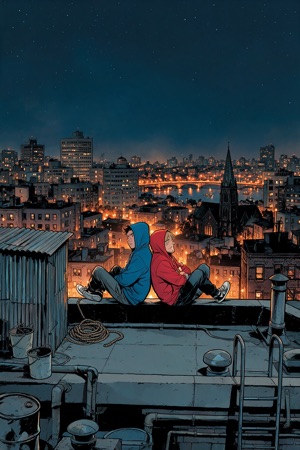
The night was a thin veil of heat and neon, the kind of March humidity that made the concrete feel like a second skin. Peter Parker stood on the edge of the rooftop, the city’s electric pulse flickering below like a nervous heartbeat. He had just wrapped up a ten-minute skirmish with a trio of street-level goons who thought they could pull a heist under the guise of a flash mob. The fight had been swift, efficient, and left him with a bruised left rib and a mental note to schedule a chiropractor appointment—something he’d never actually do.
He exhaled, the breath catching on the scent of diesel and late-night tacos drifting up from the streets. He checked his watch; the digital glow read 02:58 a.m. It was exactly the hour he had trained himself to recognize as “time to disappear.” The idea of a roof, a city that never truly slept, and a quiet moment to recalibrate was his version of a prayer.
A rustle behind him broke the stillness. He turned just in time to see a lanky figure in a red and black suit climb up the fire escape with the enthusiasm of a kid chasing a stray balloon. Wade Wilson—Deadpool—was perched on the opposite edge, knees tucked, a half-eaten bag of fast-food wrappers spilling onto the concrete. He glanced up, eyes bright, grin wider than his mouth could contain.
“Hey, Spider-Guy,” Wade called, voice bouncing off the metal rails. “You look like you’ve been hugging a wall for twelve years. (Or at least a very judgmental one.)”
Peter raised an eyebrow, the movement deliberate and measured. “If you’re trying to start a conversation, you’re doing a terrible job. I’ve been on patrol all night; I’m not in the mood for your… theatrical monologues.”
Wade held up a crumpled paper bag, the word “CHIMICHANGAS” scrawled in permanent marker, the ink smudged from an earlier spill. “I figured if I’m going to be the only one with a midnight snack, I might as well invite the most boring superhero I know. (Because you’re so boring, it’s almost heroic.)”
Peter stared at the bag as if it might contain a life-changing revelation. “I’m trying to keep my diet… balanced.”
Wade’s grin broadened, teeth flashing in the dim light. “Balanced? You mean the one that includes spider-sense, webs, and a side of regret? (Trust me, I’ve got a whole spreadsheet for that.)”
Peter’s internal dialogue was a steady metronome, counting breaths, checking vitals. “I’m not interested in your spreadsheets.”
Wade leaned forward, the city’s wind ruffling his hair, and unwrapped a chimichanga with a flourish that made the grease glisten. “Look, I’m not a chef, but I’m an expert in 2-minute meals that taste like they’ve been kissed by a taco truck and then abandoned by a Mexican-food-truck-sponsor. (If you don’t like it, I’ll eat it. If you do like it, I’ll pretend you didn’t because you’re too scared to admit you love junk food.)”
Peter surveyed the golden pastry, noting the way the cheese stretched as the heat released it. He could have ignored it, walked away, and kept his rigid schedule, but something in Wade’s chaotic energy made the world feel less like a series of equations. He sighed, the sound deliberate, like a sigh after a long lecture.
“Fine,” he said, voice flat but not unkind. “One. But this is the last time.”
Wade clapped his hands, startling a pigeon that took off with a frantic coo. “Yes! (You’re welcome for the applause. I also have a sign that says ‘Welcome to the Chimichanga Club.’ It’s a metaphor.)”
Peter took a bite, the flaky shell cracking under his teeth. The flavor was a thunderstorm of cheese, spices, and a hint of something he could only describe as “late-night desperation.” He chewed slowly, his eyes never leaving the cityscape, as if the lights could offer any more answers than he already had.
“It’s… good,” he admitted, the words measured, each syllable landing like a well-timed footstep.
Wade’s eyebrows shot up, as if he’d just discovered a new continent. “You’re welcome to my culinary masterpiece. (If you want more, I could add hot sauce. If you don’t want more, I could add more hot sauce. We could go on a hot-sauce-fueled existential crisis together.)”
Peter smiled despite himself. “I think I’ve had enough existential crisis for one night.”
A moment lingered, the kind of silence that felt like an echo of something unspoken. Wade’s gaze drifted from the chimichangas to the horizon, where the city lights bled into the pale pink of the early sunrise. Peter felt a sudden, inexplicable tug at his chest—a reminder that the world was larger than his responsibilities, larger than his need to be the perfect guardian.
“Look,” Wade said, his voice softer, the usual sarcasm dimming for a beat. “You ever think about how weird it is that we’re both out here, eating fried food at three in the morning, pretending we’re not lonely?”
Peter’s eyes met Wade’s, and for a second the world seemed to narrow to the two of them on that roof. He swallowed the last bite, the taste lingering like a memory he couldn’t quite place. “Sometimes,” he replied, the word unadorned, “I think about it.”
Wade’s grin softened into something that resembled sincerity, though it was still edged with a punchline. “Well, that’s the beauty of the city. It never sleeps, it never judges, and it always has a taco stand that’s open. (Unless you’re in a different state, then it’s just a 24-hour pharmacy with a vending machine that thinks it’s a gourmet chef.)”
Peter laughed, the sound more tired than amused. “You’re impossible.”
“Impossible is my middle name,” Wade answered, tapping his chest. “Actually, it’s not. It’s just… (you get the idea.)”
The clock on the building’s facade flickered to 03:12 a.m. The city below seemed to exhale a collective sigh, the hum of traffic softening as the night shifted toward dawn. Peter checked his watch again; his spider-sense had already begun to tingle, warning him that his next call could be imminent.
He stood, the weight of his suit pulling at his shoulders. “I should go,” he said, the words precise and deliberate, as if each syllable needed a timestamp. “There’s work to do.”
Wade waved a hand, the motion exaggerated, as if conducting an orchestra of invisible notes. “Sure thing, Spider-Man. (If you need a ride, I’ve got a motorcycle that’s technically a vehicle, but also a metaphor for freedom.)”
Peter glanced at the bike, a gleaming custom machine that seemed to pulse with its own personality. He shook his head. “I’m fine. I’ll take the stairs.”
He turned toward the fire escape, the metal ladder that would lead him down the side of the building and onto the street where a swing-like shuttle hovered, its lights blinking like a distant star. He paused, hand hovering over the railing, his eyes meeting Wade’s one last time.
“Hey,” Wade called, a hint of something uncharacteristic slipping through his usual banter. “Don’t forget to come back for the second round. (It’s a thing now. You’re welcome.)”
Peter hesitated, the phrase hanging in the air, then stepped away. The fire escape creaked under his weight, each rung a reminder of his routine, each step a measured cadence that had become his life’s metronome. He descended in silence, the city’s ambient noises growing louder with each floor.
The shuttle’s doors opened with a soft hiss as he reached the bottom. He stepped inside, the plush seats cradling his fatigue. The vehicle lifted off, swinging gently over the rooftops, the neon below turning into blurred ribbons of color.
He stared out the window, the rooftop where Wade still stood fading into the distance. A pang of something—regret, perhaps—tightened his chest. He realized he hadn’t said goodbye, hadn’t offered a proper thank you. He hadn’t even asked Wade how his night had been beyond the jokes.
The shuttle’s engine purred, and Peter’s mind slipped into the familiar rhythm of thoughts about responsibilities, deadlines, and the ever-present weight of being a hero. Yet beneath the monotony, a quiet thread lingered, a feeling that perhaps, in the chaos of his life, a simple shared meal could be a moment of genuine connection.
He let the feeling settle, unnoticed by anyone but himself. The city below was waking up, the sunrise bleeding orange into the horizon. The shuttle swayed, and Peter felt the faint tug of the wind against his suit, a reminder that even heroes needed something to hold onto when the world spun too fast.
The doors opened at his apartment building. He stepped out onto the fire escape, the metal cold under his feet. He paused again, his hand resting on the railing, looking up toward the roof where Wade would still be, perhaps still holding onto a half-eaten chimichanga, perhaps already gone. A brief, unspoken glance passed between them—a held look that said more than any joke could.
Peter turned and walked toward his door, the weight of the night settling onto his shoulders like a familiar cloak. He didn’t look back again, but the echo of Wade’s laughter lingered in his ears, a reminder that even in the darkest hours, someone else was also watching the sunrise.

The app remembers where you stopped, reads chapters aloud, and works offline. Writing lives there too.