- Stories
- Fanfiction
- Chimichangas at 3 a.m.
- September
September
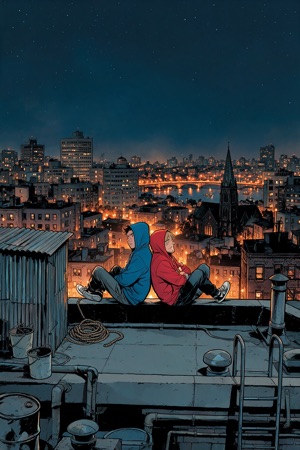
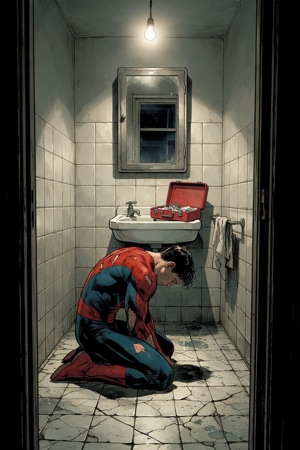
I stumbled onto the rooftop with the kind of limp that made my own feet feel like they were made of overcooked spaghetti. The city’s neon pulse was a dull throb against the night, and the wind tried to slap my bruised ribs back into line. I should have known better than to try to swing past a gang of techno-mercenaries solo; my Spider-sense was more of a sarcastic whisper than a warning this time.
When Wade turned his head, the grin on his face was the same crooked thing it always was—half-smirk, half-eyebrow, the whole thing tilted like he’d just thought of a joke that made sense only to him. He set his fork down with a clink that sounded like a tiny bell, his eyes flicking up to meet mine for a heartbeat before he dove back into the taco-sauce pool on his plate.
“Nice of you to finally show up,” he said, his voice a low rumble that seemed to vibrate through the metal rails. “I was beginning to think you’d taken a detour to the afterlife and liked it better than my cooking.”
I managed a half-laugh, the sound catching on the rasp in my throat. “If I’m going to die, at least I’d rather be the one who’s still standing when the sunrise decides it’s had enough of us.”
He raised an eyebrow, his hand slipping to the back of his neck, fingers brushing against the faint bruise that had already turned a shade darker than the night sky. “You’ve been hitting the gym hard? Or just… trying to get extra points for being a dramatic hero?”
My jaw tightened, the pain a reminder that I’d taken more than a glancing blow. “The only thing I’m getting points for is a ticket to the ER. You know, the usual superhero perks.”
He pushed his plate away with a swift, practiced motion, the ceramic shattering into a fine spray of sauce and crumbs. “Alright, let’s get you patched up before you start bleeding out and I have to call the city’s most efficient emergency services: me.”
There was an odd gentleness in the way he moved toward me, the chaotic energy that usually defined his every entrance now softened, as if he’d decided that tonight the world needed a little less fireworks and a lot more bandages. He knelt beside the railing, his hand finding the spot where my armor had dented the metal, a dark line of blood seeping through the fabric.
“Hold still,” he muttered, his tone dropping to something almost solemn. He pulled out a compact med-kit from his jacket—a thing that looked like it had been scavenged from a first-aid station for circus clowns and then upgraded with a few high-tech patches. “You’re bleeding, Peter. Not that I’m surprised; you’ve always liked to make an entrance.”
I could feel the sting of the antiseptic as he pressed a cooling strip against the wound. The pain dulled, not because the adhesive was some miracle drug, but because Wade’s fingers were steady, his grip firm but not crushing. I glanced at his face, expecting the usual sarcastic smirk, but found his eyes narrowed, focusing on the task with a concentration that made the neon glow seem almost distant.
“You always think you’re the hero, but you forget the most important part of any mission is staying alive long enough to eat the chimichanga,” he said, the words slipping out in a rapid cadence that made the moment feel absurdly intimate. “If we’re going to keep this rooftop thing going, you’ve got to keep your ribs in one piece. Otherwise, I’ll have to start serving soup, and you know how much I hate soup.”
I let out a breath that was part sigh, part laugh, and something else—something that trembled on the edge of a confession but never quite crossed the line. “You could just—”
He cut me off with a soft chuckle, a sound that resonated in the empty space between the buildings. “Save the poetry for the next time we’re both alive and not covered in bruises, okay? For now, focus on not bleeding out. I’ve got a new bandage that’s supposed to be ‘self-healing.’ It’s a joke, but the adhesive is legit.”
The patch adhered with a faint pop, the material cool against my skin, and the bleeding slowed to a thin, sticky trickle. I stared at it, at the way Wade’s hands moved to clean the excess sauce from his own chin, a smear of red and orange now staining the scar on his cheek. He didn’t try to hide it, didn’t make a joke about it; he just wiped it away with the back of his hand and gave me a look that was oddly sincere.
“Okay, you’re not dead. That’s a win,” he said, his voice softening just enough to sound like it might be real. “Now, how about we get back to the chimichangas? I’m still hungry, and you look like you could use a little more sauce to distract you from the throbbing.”
I let out a small, exhausted laugh, the kind that sounded more like a wheeze. “You know, if we keep doing this—me falling apart and you being the one who fixes me—I might start thinking you’re a better therapist than a superhero.”
He smirked, but there was a flicker in his eyes that made the grin feel less like a mask and more like a genuine expression. “Hey, I’m good at a lot of things. Healing, eating, being a walking disaster. It’s a package deal.”
We settled back onto the edge of the roof, the city sprawling beneath us like a neon ocean. I leaned against the cool metal, feeling the ache in my side settle into a dull, persistent throb. Wade pulled another chimichanga from the bag, its cheese still stretching like a lazy river of molten gold. He offered it to me with a flourish that made the gesture feel ceremonious.
“You get the first bite,” he said, his tone playful but his eyes lingered on mine longer than necessary. “Consider it a… welcome back to the living.”
I took the bite, the spice hitting my tongue like a sudden burst of fireworks. The heat rolled over my palate, and for a moment the pain in my ribs seemed to recede, replaced by the simple, stubborn pleasure of food shared in the dark. I could hear the wind whispering through the scaffolding, the distant sirens far below, the city’s endless hum—all of it forming a backdrop to the quiet that settled between us.
“It’s… good,” I managed, my voice hoarse but sincere. “Really good. I don’t think I’ve ever had a chimichanga that tasted like… redemption.”
Wade laughed, the sound a low rumble that seemed to vibrate through the concrete. “Redemption, huh? I was aiming for ‘delicious,’ but I’ll take the credit if it helps you forget you’re bleeding.”
He reached over, his hand brushing the side of my arm, the contact light enough to send a jolt through my already numb nerves. “You know, we’ve been doing this for months now. Eight-plus rooftop meals, a hundred jokes, a thousand half-hearted confessions that never get fully spoken. It’s… weird, isn’t it? How we keep coming back here, even when the world feels like it’s falling apart.”
I swallowed, the chimichanga’s sauce slicking the back of my throat. “It’s the only place that feels… normal, I guess. When the city’s a mess and the villains are a blur, this rooftop is the only thing that stays the same.”
Wade’s smile softened, the edge of his humor giving way to something quieter, more fragile. “Yeah, I get that. It’s like having a secret spot where you can be yourself without the cape, without the… responsibilities. Just you, me, and a plate of food that’s trying its best not to be a metaphor for our lives.”
I let a sigh escape, the sound carrying the weight of a night that had been anything but ordinary. “You’re good at this,” I said, gesturing to his gentle handling of my wound. “I mean, I’ve seen you pull a gun out of nowhere, hack a security system with a grin, and you still manage to be… decent when it matters.”
He shrugged, the motion casual, but there was a sincerity in the way his shoulders relaxed, as if the joke had finally left him. “I’m a jack of all trades, master of… well, at least I’m competent enough not to let you die on a rooftop. That’s a win, right?”
I laughed, the sound a little hoarse, the humor a thin veneer over something that felt more like gratitude than anything else. “A win, sure. And you’re right. I guess I’ve been… stubborn, holding onto the idea that I can handle everything on my own.”
He tilted his head, his eyes narrowing in that way that meant he was about to say something that could be both a joke and a truth. “You don’t have to be a lone wolf all the time. Sometimes, it’s okay to let someone else… guard the den.”
The wind picked up, tugging at the edges of his jacket, scattering a few stray crumbs across the rooftop. I watched a tiny piece of taco shell tumble into the darkness, disappearing like a secret. I felt the weight of my own breath, the rhythm of my heart, and the steady, unhurried pulse of his presence beside me.
“Thanks,” I said, the word simple but heavy. “For being here. For… not letting the night win.”
Wade gave a small, genuine smile that didn’t need a punchline to land. “That’s what friends do, right? We share food, we patch each other up, we make terrible jokes about romance while secretly hoping the sunrise sees us laughing together.”
I stared at the horizon where the first hint of dawn was bruising the sky, a thin line of pink spilling into the black. The city’s lights flickered, some turning off, others staying stubbornly bright. It felt like the world was holding its breath, waiting for something to happen.
I felt a hand slip around my shoulder, warm and firm, grounding me in the present. “You know,” Wade said, his voice barely above a whisper, “I think we’re better at this than we think. We’re… a team, even if we don’t have a name for it.”
My laugh was soft, almost a sigh, the humor bleeding into something more honest. “A team, huh? We could sell merch.”
He snorted, the sound mingling with the wind. “Yeah, ‘Team Chimichanga.’ I can see it now—t-shirts, hats, a line of action figures with tiny sauce packets.”
I raised my fork, the chipped metal catching the first glints of sunrise. “To the best disaster we’ve ever survived.”
He clinked his fork against mine, the metal ringing like a tiny bell, the sound echoing across the rooftop. “To the night that didn’t end in a hospital. And to the mornings that find us still standing.”
We ate in comfortable silence, the city waking around us, the sky lightening as if to approve of our unspoken pact. The pain in my ribs lingered, a reminder of how close I’d come to the edge, but Wade’s steady hand and the warm sauce on my tongue made it feel manageable, like a scar that would eventually fade.
When the last bite was gone, I pushed the empty plate off the railing, watching it tumble into the abyss below. The wind caught it, sending it spiraling like a tiny comet. I felt a sudden, quiet resolve settle in my chest—an unspoken promise that no matter how chaotic the night, there would always be a rooftop, a plate of chimichangas, and a friend who could be both reckless and gentle.
Wade stood, stretching his arms above his head, his shoulders making a soft crack that sounded almost musical. “Alright, hero,” he said, his tone back to its usual cadence, “time to swing back into the city. I’ve got a feeling the villains are still out there, and I’m not sure if they’re more scared of your punches or my cooking.”
I smirked, feeling the fatigue melt into a quiet confidence. “Let’s go. And Wade?… Thanks for… for being the one who actually knows how to patch a wound without blowing it up.”
He laughed, the sound genuine and unfiltered. “Anytime, Peter. Just remember to bring the sauce next time. It’s the only thing that keeps me from dying of boredom.”
We descended the fire escape, the metal steps creaking under our weight, the city’s pulse matching our own. As the rooftop receded behind us, I glanced back once more, catching Wade’s silhouette against the breaking dawn, his figure framed by the amber light. In that fleeting moment, the humor, the banter, the lingering ache—all of it coalesced into a quiet certainty that whatever the night threw at us, we’d always have this—this chaotic, tender, ridiculous routine that kept us both from falling completely apart.

The app remembers where you stopped, reads chapters aloud, and works offline. Writing lives there too.