- Stories
- Fanfiction
- Chimichangas at 3 a.m.
- November
November
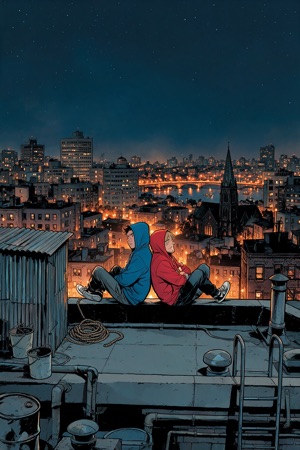
The night had slipped on its own terms, a cheap neon flicker from the billboard across the street that read “THE BEST CHIMICHANGA THIS SIDE OF THE RIVER” and then—nothing. Wade’s eyes narrowed (because they always did when the universe decided to be subtle) as he scanned the empty lot where the battered food truck usually perched like a rusted promise. He could hear the distant hum of traffic, the occasional siren, the city’s tired sigh, but no sizzle, no greasy perfume to signal the ritual.
He felt the weight of his own breathing in his chest, a quick rhythm that matched the flicker of the streetlamp above them. “Yo, Pete,” he said, voice a little too loud for a rooftop, “did the truck finally get a parking ticket or did someone finally figure out how to make a decent taco without stealing our thunder?”
Peter, perched on the edge of the concrete slab with the kind of posture that made it look like he’d been trained in a yoga studio for super-heroes, turned his head just enough to give Wade a half-smile. “It’s probably just… on break. Maybe they’re doing a whole ‘no chimichanga night’ thing. I’ve heard of a lot of things, but this one’s new.”
Wade rolled his eyes (the motion of a storm-cloud rolling across a sky that never gave a damn). “A break? Since when do trucks take a break? Do they need a spa day? ‘Ahh, let me just soak in some oil and come back with a fresh coat of rust.’”
Peter’s sigh was a sigh, not a laugh. “You’re not getting a free pass on this, Wade. You still have to patch up the roof—those new vents we installed last week are not going to seal themselves.”
Wade flopped down onto a crate, the wood creaking under his weight like a tired sigh from an old friend. He lifted a hand, twitched his fingers, and started a rapid-fire monologue. “So—(pause for effect, because I’m a professional) what do we do now? We’re standing on a roof, the city’s lights are like a glittered blanket, and there’s no food to… to… to—”
He stopped mid-sentence, a laugh bubbling up, half-genuine, half-deflecting. “…I’m kidding. I’m not kidding. We’re in the middle of nowhere without a taco. That’s a tragedy, dude. The world’s losing its balance.”
Peter’s eyes flickered, a tired gleam that seemed to carry a weight of eight months of these nights. “You’re right. It’s a tragedy.” He tapped his fingers against his own thigh, the precise rhythm of a man who counted his breaths. “And you know what they say: when the tacos disappear, the friends stay.”
Wade snorted, a sound that had the echo of a busted speaker. “If you’re quoting a motivational poster, I’m out. Look, I’ve got a plan. (Wade’s mind racing faster than a caffeinated squirrel.) We could—”
He stopped, because the night itself felt heavier than any joke. He could feel a line in the air, like a taut string that had been pulled for months and now was humming, waiting for someone to pluck it. He tried to fill the void with his usual chaos. “We could swing down, find a 24-hour diner, order a slice of pie, argue about whether the crust is ‘flaky’ or ‘just sad,’ and then—”
Peter’s voice cut in, low but not unkind. “We could also… just sit. We could just stare at the city and pretend we’re not both terrified that we’re… that we’re missing something.”
Wade’s heart thudded a little faster, not because of fear but because of the sudden absence of his usual comedic armor. He glanced at Peter, at the way the streetlights painted a halo around his silhouette, the way his breath came out in slow, controlled puffs. He wanted to say something—anything—that didn’t involve a joke about chimichangas or broken roofs. (Why is it so hard to be serious when you’re a living, breathing meme?)
The wind nudged a loose piece of paper across the ledge, skittering like a scared mouse. Wade flicked it away, but his eyes stayed on Peter. “You ever think about how many nights we’ve been up here, trading jokes like they’re currency?” he asked, voice softer, the chaos in his tone giving way to a more deliberate cadence.
Peter’s smile softened, the precise lines of his mouth easing. “All the time. It’s the only thing that keeps the world from feeling… too quiet.” He let the words hang, as if he’d been careful not to let the silence swallow them.
Wade’s grin cracked, not with humor but with a hint of something raw. “I guess that’s why we keep coming back, right? Even when the truck’s gone, even when the jokes feel… stale.” He made a small, almost imperceptible gesture with his hand—an involuntary curl of his fingers, a sign of nervous energy that he’d never admit to anyone but himself.
Peter looked at him, the kind of look that meant he could read the code hidden in Wade’s chaotic language. “You don’t have to make a joke about everything, you know,” he said, and his voice was a low hum that seemed to vibrate the very metal beneath their feet.
Wade let out a breath that sounded like a sigh and a laugh at the same time. “I know. It’s… it’s just hard to turn the dial down, Pete. I’m used to the volume being maxed out. (Maybe I’m scared of the quiet. Maybe the quiet means I have to look at… at you, without the filter of sarcasm.)”
Peter’s eyes met his, and for a moment the rooftop felt smaller, the city’s noise a distant murmur. “You’re not the only one scared of the quiet,” Peter admitted, his voice barely above a whisper. “I’m scared that if we stop talking like this, we’ll lose… something. I don’t know what it is, but it feels important.”
Wade’s heart did a small, stubborn flip. He had spent so long hiding behind jokes, behind the endless cascade of puns and profanity, that the idea of an honest moment was both terrifying and exhilarating. He shifted his weight, feeling the cracked concrete under his boots, and let the silence sit between them a little longer.
A distant siren wailed, then faded. A car horn blared far off, then a low rumble of a subway train passed under the street, shaking the rooftop ever so slightly. The city’s pulse continued, indifferent to their tiny exchange, but Wade could feel his own pulse sync with it, a steady rhythm that seemed to say, “You’re not alone.”
He tried to break the tension with a half-joke, a habit he couldn’t shake. “So, you think the truck is on a vacation? Maybe it’s in Cancun, sipping margaritas, watching us struggle with our stomachs.” He laughed, but the sound didn’t carry the same weight as before.
Peter’s laugh was softer, more genuine. “Maybe. Or maybe it just decided it’s time we learned how to survive without it.” He gestured to the empty lot, to the dark sky that stretched above them. “We’ve been good at surviving anyway, haven’t we?”
Wade’s grin widened just enough to show a flicker of sincerity. “Yeah, we have. We’ve got each other’s backs, even when we’re not sure what the back actually looks like.” He tapped his chest, then pointed at Peter’s. “And we’ve got… something else, I think. Something that doesn’t need a truck to remind us it exists.”
Peter’s eyes glistened for a split second, a sheen that caught the streetlamp’s glow and turned it into a tiny mirror. He didn’t say anything, but his posture leaned a fraction closer, an unspoken invitation to share the space, the silence, the night.
Wade felt his own breath catch, his chaotic mind suddenly quieted by the realization that the routine had become more than just a joke about greasy food. The night, the rooftop, the city—all of it seemed to hold its breath with them, waiting for something to happen, even though nothing would be declared out loud.
The wind shifted, carrying a faint scent of rain that hadn’t yet fallen, a promise of change that hung in the air like an unfinished sentence. Wade lifted his hand, half-intended to gesture at the empty lot, half-intended to reach for something intangible, and then he let his fingers fall back to his lap.
Peter’s hand moved almost imperceptibly, the tip of his index finger brushing the edge of his own jacket, a silent acknowledgment of the moment that was both absurd and profound. Their eyes locked, a held look that said more than any joke ever could, more than any patch of steel or swing through the city could convey.
In that suspended instant, the city’s lights flickered, the night breathed, and the world felt both vast and intimately small. The absence of the food truck was a void that suddenly seemed filled with something else—an unspoken understanding, a quiet certainty, a fragile hope. And as the rooftop swayed ever so slightly under the weight of their shared silence, they both knew that whatever the next night brought, this—this strange, chaotic, tender, ridiculous routine—was the thread that kept them from falling apart.

The app remembers where you stopped, reads chapters aloud, and works offline. Writing lives there too.