- Stories
- Fanfiction
- What Sasuke Wrote and Never Sent
- To the Idiot
To the Idiot
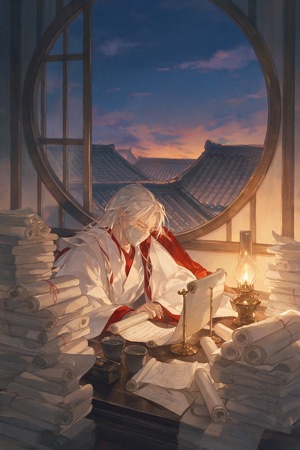
He sat at the wooden desk that had once held a ledger for the village’s ration distribution. The paper was thin, the kind that tore when you brushed it too hard. He laid the quill beside a half-filled ink bottle, the last drops dark against the straw. The ink was the colour of night after a storm, the same colour he had seen reflected in the river when he first left Konoha.
His fingers hovered over the page. He could hear the wind rustling the leaves outside the small hut. It was the same wind that had carried the scent of pine when he and Naruto had trained together, years ago. He pressed the quill to the paper, and the first line came out as if it were a habit he could not break.
“Hey, idiot,” he wrote, the word landing on the page like a stone dropped in a pond. The ripples spread through his mind, and he stared at the single word. He could feel the sting of a memory he tried not to think about—the way Naruto had laughed at his seriousness, the way he had called Sasuke a “genius” and then a “monster” in the same breath.
He wrote another line, slower this time. “You still think you’re the hero of the village, don’t you?” He imagined Naruto’s grin, bright and reckless, the way he’d always turn a fight into a joke. Sasuke’s eyes flicked to the edge of the desk where a small wooden box sat, its lid slightly ajar. Inside were the receipts for the supplies he had taken from the market the day before, the tally of rice, the count of mushrooms, the list of broken tools he had repaired for the village children. He noted the numbers in his head: thirty-two bowls of rice, thirteen bundles of fire-weed, two cracked shuriken that he had glued back together with a piece of bark.
He wrote, “You still charge ahead without looking at the ground.” The words felt like a reprimand, but also a confession. He remembered how Naruto had once tripped over a stone and fallen into a river, how he had laughed at his own clumsiness, how Sasuke had helped him out. He saw the image of Naruto’s bright eyes, his unending optimism, and he felt a pang he could not name.
He turned the page, his hand steady despite the weight of his thoughts. The ink bled into the fibers, forming a line that was both accusation and apology. “You never learn to stop talking, do you? You think your voice can fill the silence.” He paused, the quill resting against the margin. The silence he spoke of was not the quiet of the night, but the emptiness that grew after every battle, after every promise broken. It was the silence that lingered in the halls of the Hokage’s office when the paperwork was stacked high, the silence that settled over the training fields when the sun set and the shinobi left their swords in the grass.
He looked at the ledger again, the numbers now a blur. He counted the days he had been away: three hundred and sixty-five. He thought of the letters he had never sent, the words that had piled up like the supplies he had counted. He wrote, “You think you’re the only one who can make a difference. You think the world revolves around your smile.”
A faint rustle came from the doorway. A breeze slipped through the cracks, carrying with it the distant sound of children’s laughter. Sasuke’s gaze fell on the small wooden box again. Inside, beneath the receipts, lay a single piece of paper torn from a notebook. It was a list of names, written in a hurried hand—Naruto, Sakura, Kankuro, Shikamaru. He could almost see the ink fading, the way the letters had bled together when the rain had seeped through the roof that night.
He added, “You always say you’ll protect everyone. You forget that protection is a contract, not a promise.” He thought of the contracts he had signed, the agreements he had made with the village elders, the promises he had whispered to the dead. He thought of the night he had stood over the graves of his clan, the cold wind that had taken his breath away, the way his own heart had felt like it was breaking into a thousand pieces.
He pressed his thumb against the paper, feeling the texture of the fibers. He could hear the faint clink of metal from the forge where the village blacksmith was working. The sound reminded him of the clang of swords, of the battles they had fought side by side. He wrote, “You’re loud enough to drown out everyone else’s voice. You never listen, even when the world is screaming at you.”
He lifted his gaze to the window. The sky was a dull grey, the kind that made the whole village feel heavier. He could see the roofs of the houses, the little garden where a boy named Shikamaru had once tried to grow carrots. The garden was now overgrown, weeds pushing through the soil. He thought of the way Naruto had tried to coax a smile out of the old man who tended it, how he had called him “the strongest idiot” and then helped him pull the weeds. He smiled, a small, almost imperceptible curve of his lips.
He wrote, “You call yourself a fool, but you’re the only fool who still believes in a brighter tomorrow.” The words felt like a paradox. He imagined Naruto’s laughter, the way it echoed through the training grounds, the way it made even the most hardened shinobi feel lighter. He felt a sudden urge to stand, to walk outside, to watch the world keep turning while he stayed inside, writing letters that would never be read.
He turned the page again. The quill scratched across the fresh surface, leaving a line that seemed to crack under the pressure. “You think you’re the only one who can carry the weight of the village. You don’t know what it feels like to have that weight on your shoulders alone.” He thought of the night he had stood watch over the village, the cold wind biting his skin, the stars hidden behind clouds. He remembered the way his breath formed a mist, the way his heart beat in rhythm with the distant drums of a festival he could not attend.
He glanced at the small box once more. Inside, among the receipts, a single dried leaf lay, curled at the edges. It was a leaf from the tree outside his hut, the one that had shed its leaves early this year. He thought of the seasons, of how everything changed, of how the leaf fell and became part of the earth. He wrote, “You think you can outrun the past. You can’t. It’s like trying to outrun the wind. You’ll only end up chasing shadows.”
He let the quill rest, his hand trembling slightly. He could hear the faint murmur of the village below, the low hum of voices, the rustle of paper in the office where the records were kept. He imagined the Hokage’s desk, the stack of reports waiting for a signature. He thought of the administrative burden that kept the village alive—the taxes, the ration distribution, the repairs. He realized how those mundane details were the threads that held everything together, how they were the quiet grief of those who stayed behind.
He wrote, “You think the world needs your light, but sometimes light blinds more than it reveals.” He thought of the time Naruto had tried to set a fire to keep the village warm, the fire that had nearly burned down the storage house. He remembered the panicked faces, the hurried shouts, the way Sasuke had stepped in to pull the burning beams apart. He felt a sting of memory, a reminder that even his anger was born from moments when he had saved Naruto from his own recklessness.
He stared at the page, the ink dark as night. He could see his own reflection in the glass of the window, the lines on his face deeper than he cared to admit. He thought of his hair, the way it fell over his eyes, the way he had once tied it back for a mission. He thought of his hands, scarred from countless fights, still steady enough to write these words.
He added, “You’re a storm that never knows when to stop. You crash into everything, even the things you love.” He felt the words settle in his chest, heavy like the weight of a sword sheathed at his side. He imagined the sound of the sword’s metal against his thigh, the small vibration that traveled through his bones.
He paused, the quill hovering. The ink had begun to dry, forming little beads on the page. He thought of the rain that would fall later, the way it would soak the ground and make the weeds grow faster. He imagined the rain soaking the paper, the words smearing, the letters blending together. He wondered if the rain would wash away his anger, or if it would simply make the ink bleed into the memory of the page.
He wrote, “You think you’re the only one who can forgive. You’re not.” He let the sentence linger, feeling the truth behind it. He thought of the night he had stood before his brother’s grave, the silence that had spoken louder than any confession. He thought of the apology he could never give, the words he could never speak.
He lifted his head, looking out at the village square where a few people lingered, their heads bent over ledgers, their hands moving pens across paper. The administrative work of keeping a village alive was a quiet battle, fought in ink and numbers. He thought of the way Naruto would have laughed at the sight of him, the way he would have teased him about his seriousness, about his love for order.
He wrote, “You’re the idiot who keeps everyone alive, even if you don’t realize it.” The words felt like a knot untangling. He could hear the distant clatter of a pot being set down, the soft sigh of someone closing a drawer. He imagined the simple act of closing a door, the small motions that kept the world turning.
He placed the quill down. The page was filled with accusations, each one a thin veil over something softer. He folded the paper carefully, the crease crisp against his fingers. He slipped it into the wooden box, next to the receipts and the dried leaf. He could feel the weight of the box, the weight of the unsent letters, the weight of a year spent wandering and counting days like inventory.
He stood, stretching his shoulders, the muscles in his back protesting after hours of sitting. He walked to the window and opened it, letting the cold wind rush in. It brushed against his cheek, bringing with it the scent of pine and distant sea. He stared at the horizon, where the sun was beginning to set, painting the sky in muted orange. He thought of the village, of Naruto’s laugh, of the noise that filled his mind like a storm.
He thought of sending the letter, of putting it in the mailbox that stood near the market. He imagined the postman taking it, the wind carrying it to Konoha, the ink drying as it traveled. He imagined Naruto opening it, his eyes widening, his smile faltering for a moment before returning. He pictured Naruto’s reaction, the way he would laugh and then shake his head, calling Sasuke an idiot again.
He lifted the box, feeling the paper inside shift. He placed it on the shelf, next to the other letters he had written—one for Sakura, one for Itachi, one with no name. He knew he would never send any of them. He knew the words were his only way to speak, the only way to keep the grief at bay.
He sat back down, the desk creaking under his weight. He took a breath, the air cold and crisp. He felt the quiet of the evening settle around him, the soft hum of village life drifting through the open window. He stared at the empty space on the page, the part of the letter that remained unwritten.
He thought, perhaps, he would write another line. Perhaps he would write, “I miss you,” but even that felt too much. The letter already held enough weight. He closed his eyes, letting the darkness of the room match the ink on the page.
He turned off the lamp, letting the shadows swallow the room. The unsent letter lay on the desk, a silent testament to a friendship that survived wars, to an idiot who never learned to stop talking, and to a brother who could only speak through words never meant to be read. He left the room, the door closing softly behind him, the quiet grief lingering like a faint scent of pine in the night.

The app remembers where you stopped, reads chapters aloud, and works offline. Writing lives there too.