- Stories
- Fanfiction
- What Sasuke Wrote and Never Sent
- To My Brother
To My Brother
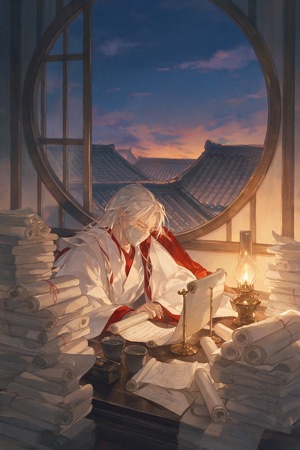
He set the empty parchment on the low table beside the tea kettle. The kettle hissed, steam curling in thin ribbons. The fire in the hearth sputtered, throwing amber shadows across the walls. He reached for the inkstone, feeling the familiar weight of the smooth black slab. The ink was thick, dark as the night he left Konoha. He pressed the brush against it, the bristles catching a small bead of pigment.
The room was quiet except for the occasional creak of the wooden floorboards. A sparrow had found its way into the eave and tapped a thin rhythm against the plaster. He watched it for a moment, then turned his attention back to the paper.
He thought of the list of supplies he had to file that morning: a request for more rice for the orphanage, a repair order for the broken well in the southern district, a notice to the council about a stray dog that kept digging up the garden. The paperwork was endless, a tide he could never quite outrun. He filled out each form with the same careful hand he used for his letters—precise, restrained. The ink bled slightly where his pressure lingered too long. He smiled faintly at the memory of the village clerk, Shiro, who insisted on a stamp in the corner of every document, even the ones that never left the desk.
It was a small joke, the way Shiro would argue that a stamp was a promise. He would say, “Even if no one reads it, the stamp says we tried.” Sasuke imagined Shiro’s face, serious as a magistrate, yet his eyes twinkling with a mischievous spark. The humor was thin, but it cut through the heaviness of the day. He pressed the stamp onto the letter, a dark circle of ink that looked like a moon.
He wrote the name at the top, but left the address blank. The paper already smelled faintly of pine and the sea he had walked past months ago. He let the brush glide across the surface, each stroke a measured step across a bridge he knew he would never cross.
It began with a simple line, as many of his letters did.
“It has been five years, Itachi.”
The sentence hung in the air, a quiet acknowledgment of time. He did not add a greeting, no “Dear brother.” The absence felt appropriate, as if the lack itself could hold the weight of what he could not say.
He thought of the night they both sat on the roof of the Uchiha compound, watching fireworks bloom in the sky. Itachi had laughed, a sound that was almost a whisper. He had asked Sasuke what he wanted most. Sasuke had said nothing, because he could not imagine a future that did not involve a battle. He had also thought of the night he found Itachi’s note, the one written in a careful hand, urging him to leave the village. He had taken that note to heart, but the road it led him down was paved with blood and solitude.
He wrote about the village’s recent harvest. The fields were green, the crops heavy. The mayor had praised the farmers for their diligence. The new tax ordinance required each household to report their yields by the end of the month. He noted the absurdity of counting grains when the world had once been torn by war. He wrote, “The village now measures its peace in bushels, not in battles.”
He paused, the brush poised over the paper. He could feel the sting of his own breath in the cold air of the room. The candle on the windowsill flickered, casting a wavering light that made the ink look like blood. He thought of the night he had hidden the first letter to Naruto in his coat, the way the paper had crinkled against his chest. He wondered if he would ever be able to hide his grief as neatly.
He turned the paper over, looking at the blank space he had left for the body of the letter. He imagined Itachi’s eyes, the dark hollows that seemed to hold a whole universe of sorrow. He imagined the weight of his brother’s gaze, as heavy as a mountain. He imagined the voice that had once told him to be strong, to endure.
He began again, slower this time.
“The world has settled into a rhythm I cannot hear.”
He described the rhythm of the village: the market opening at dawn, the blacksmith’s hammer ringing against steel, the fishermen returning with their nets full of silver fish. He wrote how the townspeople greeted each other with a nod, a smile, a quick exchange of pleasantries. He wrote about the way the old woman at the tea stall always offered him a second cup, even when he declined. He noted the way she would say, “You look tired, Sasuke. Rest your eyes.” He wrote that she did not know his name, only the name the village gave him.
He described his own work. He had taken a position as a clerk, sorting records, filing reports. He spent hours in the archive, tracing the lineage of the Uchiha, the names of those who had perished. He listed the dates, the names, the circumstances. He wrote, “I have learned that the past is a ledger, each entry immutable.”
He thought of the day he had found a photograph of their father in the old records. The photo showed a man with a calm smile, eyes that seemed to look beyond the page. He remembered the way his father had held them both on a cold winter night, his breath fogging the air. He wrote, “I keep the photograph in my pocket, but I never look at it. It is a reminder of a life that never was.”
He felt a flicker of humor rise, thin as a candle flame. He wrote, “Shiro still insists on stamping every document, even this one. He says a stamp is a promise. I promise to keep your memory in the margins of my life, though I never finish the sentence.”
He let the ink dry for a moment, watching the droplets bead and spread. The silence was heavy, but not oppressive. It was the kind of silence that made the mind turn inward, where thoughts could be examined without the need for applause.
He wrote about the night he had gone to the hill outside the village, the one where the wind sang through the pines. He remembered how the moon was a thin crescent, like a knife. He remembered how the grass brushed his knees, how the stars seemed indifferent to his sorrow. He wrote, “I stood there and felt the cold bite at my skin. I thought of you, and the words you never said. I thought of the night you left us, and the night you chose to stay.”
He paused again, feeling the ache in his chest tighten. He could not pretend that the ache would vanish because he wrote it down. He could not pretend that the letter would be a release. He could not forgive himself by the act of writing. He could only lay out the facts, the details that made up the days he lived, the small moments that built his world.
He wrote, “I have learned to count the days, not the deeds. I have learned to tend to the garden, not the battlefield. I have learned that the world moves on, even when we are stuck in the same place.”
He remembered the first time he had tried to summon chakra after the war, the way his hand trembled, the way his breath came shallow. He wrote, “My chakra is a faint ember now. It sparks when I think of the village’s children, when I see a stray cat curl up on my doorstep. It is not the fire that once burned in my eyes.”
He added a line about the cats. A stray had taken to sitting on his windowsill, watching him write. It would flick its tail, blink lazily, then hop down and disappear into the night. He wrote, “The cat watches me, as if it knows the letters I cannot send. It does not judge. It merely observes, like the moon.”
He thought of the night he had spoken to Naruto, the way Naruto’s grin had seemed to say, “You’re still here, brother.” He wrote, “Naruto’s laughter still rings in my ears. It is a sound that makes the walls of my heart tremble. I am grateful for that, even if I cannot say it out loud.”
He added a small note about the village’s annual festival, the lanterns that floated into the sky like fireflies. He wrote, “The lanterns rise, carrying wishes I cannot name. I watch them from the hill, and I wonder if they ever reach the heavens, or if they simply dissolve into night.”
He paused, feeling the weight of the blank space at the bottom of the page. He could not fill it with grand declarations. He could not make his brother’s death a turning point that erased all his failures. He could not say that he had forgiven himself. He could only say what was true.
He wrote, “I am still walking, still carrying the weight of a name that was given to me before I was born. I am still trying to be the person you wanted me to become, even if I never meet your eyes again.”
He closed the letter with a single word, a name he could not pronounce without pain.
“Itachi.”
He set the brush down, the bristles dry and stiff. He pressed the seal, a small piece of wax he had melted from a candle, pressing his finger into it to leave an imprint. He did not have an address. He did not need one. He folded the parchment carefully, aligning the edges, the same way he aligned the rows of tax forms on his desk.
He placed the folded letter into the envelope he had kept in his pack. The envelope felt heavier now, not because of the paper, but because of the silence that settled around it. He slipped it back into his pack, the same pack he had taken on his wandering years. He felt the strap against his shoulder, a familiar pressure.
He stood, stretching his arms, feeling the ache in his back from hours of sitting. He walked to the window and opened it, letting the night air rush in, smelling of pine and distant sea, just as it had when he left the village five years before. He looked out at the village lights, tiny points of amber in the dark. He could see the silhouettes of the houses, the shape of the well, the outline of the market square. He imagined the villagers sleeping, their breaths slow and even. He imagined them unaware of the letters he wrote, the words that never left his hands.
He thought of the night he had written to Naruto, the night he had written to Sakura, the night he had written this one. Each letter a promise he could not keep, each envelope a secret he would carry until the end of his wandering. He felt the grief settle, quiet as pine scent in the night, and he let it linger. He did not expect forgiveness. He did not expect redemption. He only expected the next day, the next form to file, the next lantern to watch rise.
He turned back to his small room, the fire now a faint glow. He picked up his quill again, not to write another letter, but to make a note for the next day’s inventory. He wrote the number of rice sacks, the amount of wood needed for the winter, the name of the cat that had stolen his ink. He smiled at the absurdity of it all, the way the world could be reduced to numbers and ink stains.
He finished the note, folded it, and placed it on the table beside the unopened envelope. He knew the letter would never travel beyond his pack. He knew the words would never be read by the brother whose eyes he could no longer see. But the act of writing gave shape to the emptiness inside, a shape that could be held, even if only by himself.
He sat down, the chair creaking under his weight, and took a sip of tea. The tea was warm, the bitterness grounding. He stared at the steam rising, watching it fade into the night. He felt the quiet settle around him, a companion as steadfast as the pine trees outside.
He thought of the future he could not predict, the past he could not change. He thought of the letters that would remain in his pack, the promises that would stay unfulfilled. He thought of the weight of silence, of words that never left his mouth.
He let the night stretch on, the fire sputtering, the candle flickering, the paper in his pack waiting. The grief lingered, quiet as a pine scent in the night, and he let it settle, knowing that some words were meant only for the silence that heard them.

The app remembers where you stopped, reads chapters aloud, and works offline. Writing lives there too.