- Stories
- Fanfiction
- What Sasuke Wrote and Never Sent
- Unaddressed
Unaddressed
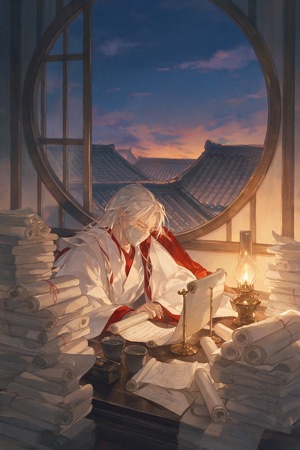
He unfolded a fresh sheet of thin paper and placed it on the low table beside the lantern. The lantern sputtered, casting a thin circle of light that barely reached the edge of the paper. He lifted the brush, dipped it in the ink, and let the tip rest on the page. There was no name at the top. He did not think of a name. He thought of the empty space that had grown between his thoughts and the world for seven years.
The first line was simple. “I have been here longer than the pine trees.” He paused, feeling the weight of the ink as it settled into the fibers. The pine trees outside the window had grown a few more branches since he first arrived. He could hear the wind through the needles, a soft rustle that reminded him of the sound of his father's voice before the war. He did not remember the exact words, only the tone. It was a tone that had once guided him, now only a memory.
He wrote about the chores that filled his days. He recorded the number of barrels of water he fetched from the well each week. He noted the broken shuriken he repaired in the evenings, the way the metal sang against the stone. He mentioned the tea he brewed each morning, the bitter taste that lingered on his tongue longer than the sweetness of the honey he added to make it bearable. He wrote, “The tea is still bitter, but the kettle is clean.” It was a small triumph, and he allowed himself a brief smile.
He described the paperwork that kept the village’s supply rooms in order. He listed the deliveries of rice, the inventory of scrolls, the requisition forms for new weapons. He wrote that the clerk in the office still misplaced the same file every month, and he had learned to file it under “Lost.” He added a line of humor: “If the paperwork were a shinobi, it would have more folds than a thousand-leaf scroll.” He did not laugh out loud. The humor was a quiet acknowledgment that even the smallest absurdities survived the war.
He thought of the night watches. He recounted how the moon rose over the ridge and painted the fields in silver. He noted the way the fireflies gathered in the courtyard, their lights blinking like distant lanterns. He wrote, “The fireflies are the only soldiers that never die.” He imagined the insects marching in formation, a silent parade that never required orders.
He wrote of the village’s festivals, the way the children ran through the streets with paper fans, the way the elders sang old songs that no one remembered the words to. He mentioned the new bridge they built over the river, its wooden beams polished until they shone. He said, “The bridge holds more than water; it holds hope.” He added, “Hope is a strange thing. It makes you walk on it even when you cannot see the other side.” The sentence lingered on the page, a quiet confession.
He paused, the brush hovering over the paper. He realized he had been writing about everything but the one thing that had driven him to the mountain. He stared at the blank space where a name would normally sit. He thought of the people he had left behind, of the promises that never left his mouth, of the silence that had become his companion. He thought of the boy who had once called him an idiot, the girl who had waited for his return, the brother whose eyes he could no longer see. He thought of the village that had survived, the people who had moved on.
He began to write, “To the one who never asked for anything.” He did not know why the words felt right. He did not know who the one was. He wrote, “You gave me a reason to walk again, even when the road was broken.” He wrote about the first sunrise he had witnessed after the war, the way the light filtered through the mist and painted the hills gold. He wrote that the sunrise reminded him of a promise he had never spoken: to protect, to watch, to endure.
He listed the items he had repaired: a broken fence, a cracked pot, a torn coat. He noted the small successes that kept him grounded. He wrote, “I have learned to mend things that are not broken.” He added a line of humor, “If only my heart could be fixed the same way.” He did not expect a laugh. The humor was a way to keep the grief at a distance.
He wrote about a night when a stray cat entered his dwelling, its fur black as night, its eyes shining like lanterns. He described how he fed it rice, how it curled up on his lap, how it purred in a rhythm that reminded him of a distant drum. He wrote, “The cat has taught me patience, even if it only stays for a bowl of rice.” He thought of the cat’s name, but he could not remember it. He wrote, “Call it whatever you like; it does not matter.” The simplicity of the line made the paper feel lighter.
He felt the weight of the ink settle. He glanced at the scroll and realized that the letter had become a record of his life, a ledger of his existence. It was not addressed to anyone he could name. It was a collection of moments, of mundane details that held the shape of his grief. He wondered if anyone would read it, if anyone would understand why the smallest things mattered so much.
He lifted the brush one last time, and wrote, “I will send this to the post office tomorrow. Perhaps it will find a home where it belongs.” He added, “If it does not, it will at least have left my pack.” He set the brush down, let the ink dry, and folded the paper with the care of someone handling a fragile piece of glass.
He rose from the low table, his joints creaking like old wood. He walked to the window and looked out at the village. The lanterns flickered in the streets, the smoke from the hearths rose in thin ribbons. He thought of the faces he had never seen again, of the ones he had never met. He thought of the people who would read his words if they ever did. He thought of the night when the wind had carried a leaf across the river, and how that leaf had traveled farther than any of his steps.
He took a breath, inhaling the scent of pine and damp earth. He stepped outside, the cool air biting his cheeks. He walked down the stone path that led to the post office, his sandals making a soft clack on the stones. He passed the market stalls where a vendor was haggling over the price of dried fish. He nodded, and the vendor returned the gesture with a half-smile. He passed the well, where a child was drawing circles in the water with a stick. He watched the circles expand and fade, a silent reminder that things could disappear without a trace.
When he reached the post office, the wooden sign above the door creaked in the wind. Inside, the clerk—a middle-aged man with a scar across his cheek—looked up from his ledger. He greeted Sasuke with a nod, and Sasuke returned the nod, his eyes briefly meeting the clerk’s. The clerk asked, “Anything special today?” Sasuke’s reply was a simple, “Just a letter.” He placed the folded paper on the counter.
The clerk examined the envelope. It was plain, no name, no address. He raised an eyebrow, then smiled thinly. “Where to?” he asked. Sasuke thought for a moment. The answer was not a place on a map. It was a thought, a hope. He said, “Send it where it can be found.” The clerk nodded, as if he understood, and placed the envelope in the outgoing bin.
Sasuke stepped back onto the street. He watched the envelope disappear among the other letters, each one bearing a destination, a name, a purpose. He felt a strange lightness, as if a part of his burden had been lifted. He turned toward the pine grove, the wind rustling the needles, the scent of resin filling his lungs. He walked slowly, the evening sun casting long shadows on the ground.
He thought about the line he had written: “To the one who never asked for anything.” He realized now that the one was not a person he could name. It was the quiet that had lived in his chest, the emptiness that had become a companion. It was the village that had survived without his help, the people who had built their lives while he was away. It was the future that waited beyond the pine trees, unseen but inevitable.
He stopped by the river, the water flowing steady and unhurried. He knelt and placed his hand in the cold stream, feeling the current slide past his fingers. He watched the ripples spread outward, reaching the banks and then receding. He thought of the letter drifting downstream, reaching a shore he could not anticipate. He thought of the possibility that someone might read his words, that they might find solace in the ordinary details he had recorded.
He rose, feeling the chill of the water on his skin. He turned back toward the village, the path illuminated by lanterns that swung gently in the breeze. He passed the house where the cat still slept on the hearth, its fur still warm. He smiled, a faint curve of his lips, and whispered, “Even a stray can be a teacher.” The cat opened its eyes, stared at him, then closed them again, as if to say, “I know.”
He entered his small dwelling, closed the door, and sat at the low table once more. The lantern flickered, the fire in the hearth crackled softly. He poured a cup of tea, the bitterness grounding his thoughts. He watched the steam rise, the way it curled and vanished into the night. He felt the quiet settle around him, a companion as steadfast as the pine trees outside. He thought of the future he could not predict, the past he could not change. He thought of the letters that would remain in his pack, the promises that would stay unfulfilled. He thought of the weight of silence, of words that never left his mouth.
Now, one piece of paper was gone. It had left his pack and traveled beyond his sight. He let the night stretch on, the fire sputtering, the candle flickering. He felt a small shift inside, a subtle loosening of the knot that had bound his heart. The grief lingered, quiet as a pine scent in the night, but it no longer pressed so hard against his chest. He let it settle, knowing that some words were meant only for the silence that heard them, and some were meant to be sent, even if the sender could not name the recipient. He lifted his cup, took a sip, and let the warmth spread through him, a quiet affirmation that even in a world scarred by war, the smallest acts—writing, sending, drinking tea—could still carry meaning.

The app remembers where you stopped, reads chapters aloud, and works offline. Writing lives there too.